
Want to see Raider King content first? Add us as a preferred source.
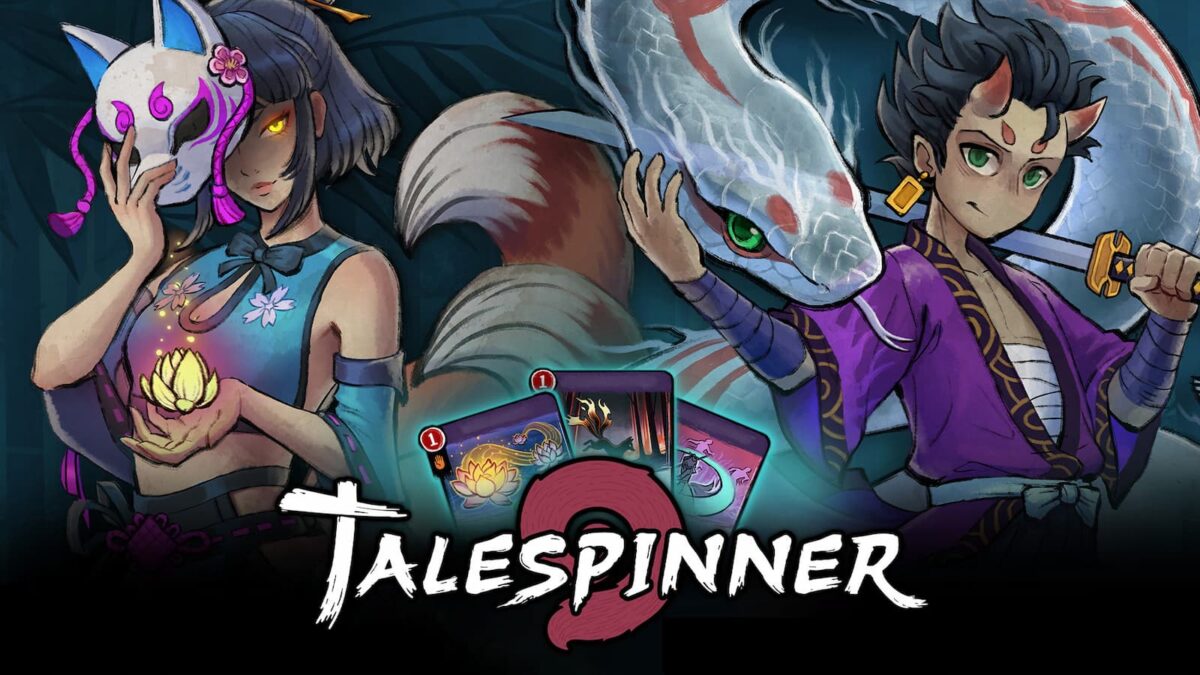
On August 6, 2026, Flash Cat Games will release their turn-based roguelike title, Talespinner, to the world. This game promises a fun, card-based battle system where players fight their way through nine stages based on Japanese mythology, filled with enemies, as they slowly build up their deck with nearly 200 different card abilities and become powerful enough to slay even the deadliest yokai. With a unique concept and a promising gameplay gimmick, is this game worth picking up or should gamers spin another tale? Let’s dissect the game piece by piece and make the decision for ourselves.
An Engaging Battle System
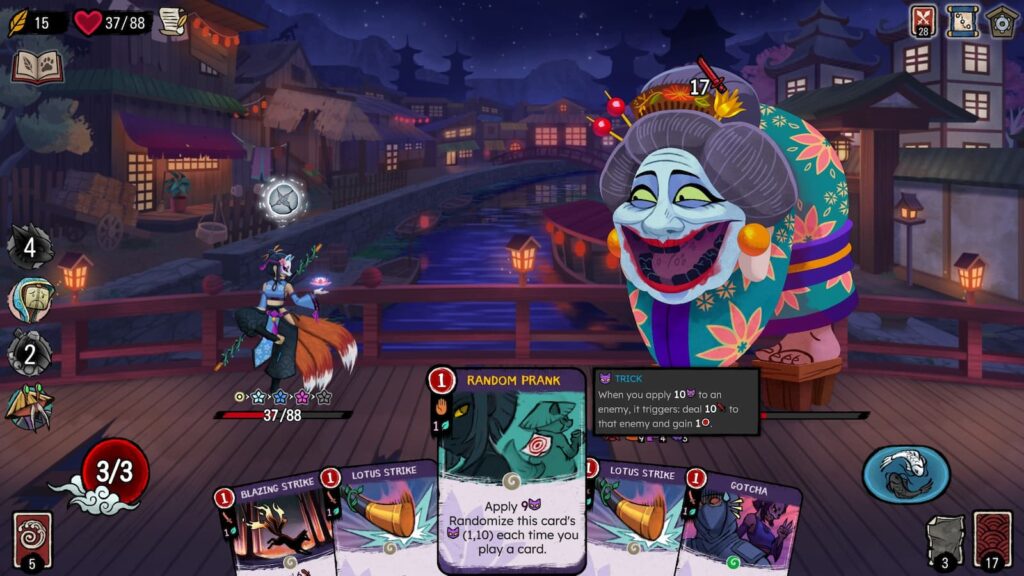
Talespinner’s combat takes the form of a turn-based RPG with a card shuffling system where the player will need to select skills from their deck (which are randomly selected each turn) to fight against enemies. Each turn, the player can select three attacks by default, but various skills and cards can increase the number of attacks you can play per turn.
While the player may be tempted to launch their most powerful attacks and attempt to kill enemies as quickly as possible, that is a one-way road to dying within the first few fights of a run. The player does not begin with much health at all in Talespinner, and the game will be providing very few ways of recovering the health they lose.
Each turn, the amount of damage enemies will inflict upon the player will be displayed over their head. If the player doesn’t apply a number of shields to themselves equal to or higher than that number, they will take damage. This results in the game encouraging the player to play very passively during the beginning stages of their run, opting to use multiple shield-applying cards per turn instead of attack cards.
This passive style of gameplay can be quite frustrating at the beginning of a run, but it can result in a feeling of pure euphoria as you build your deck and create playstyles which will allow you to be on the offensive for fights near the end of your run.
Many cards will also have additional effects aside from dealing damage and applying shields to yourself. These effects often come in the form of buffs toward yourself, debuffs toward enemies, or additional damage if the card is played under specific conditions.
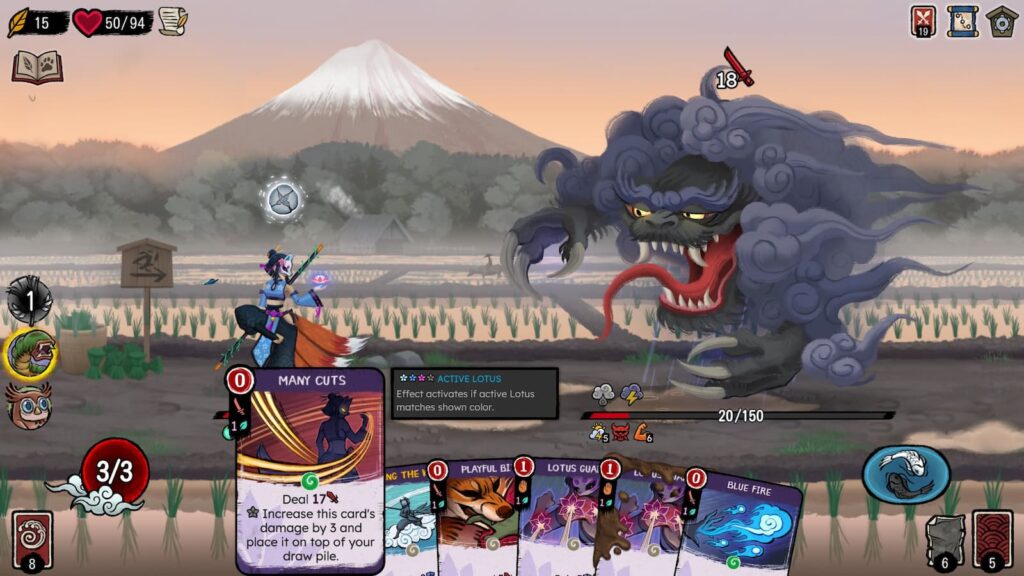
My personal favorite method for blazing through the game was to take advantage of [name]’s Trick debuff cards, as when ten of these are stacked onto a single enemy, that enemy will take massive damage. Combine that with skills which increase the amount of damage it does, companions which recast cards, and a particularly deadly skill which inflicts enemies with 20 Trick debuffs 2 turns after you cast it, and you have the perfect recipe for taking hundreds of HP away from bosses.
Aside from their cards, players will also be able to recruit multiple companions via random events or shop purchases to help them in their current run. These companion skills can range from a moderate buff like being able to keep your shields for an extra turn every six turns to complete game changers like always playing the fifth card in your turn twice.
Overall, I found the gameplay of Talespinner’s battles to be very interesting and engaging whenever I had the chance to build my deck how I wished and take down enemies in satisfying ways. However, I didn’t always get that opportunity due to the game’s structure as a roguelike.
Pure Randomness
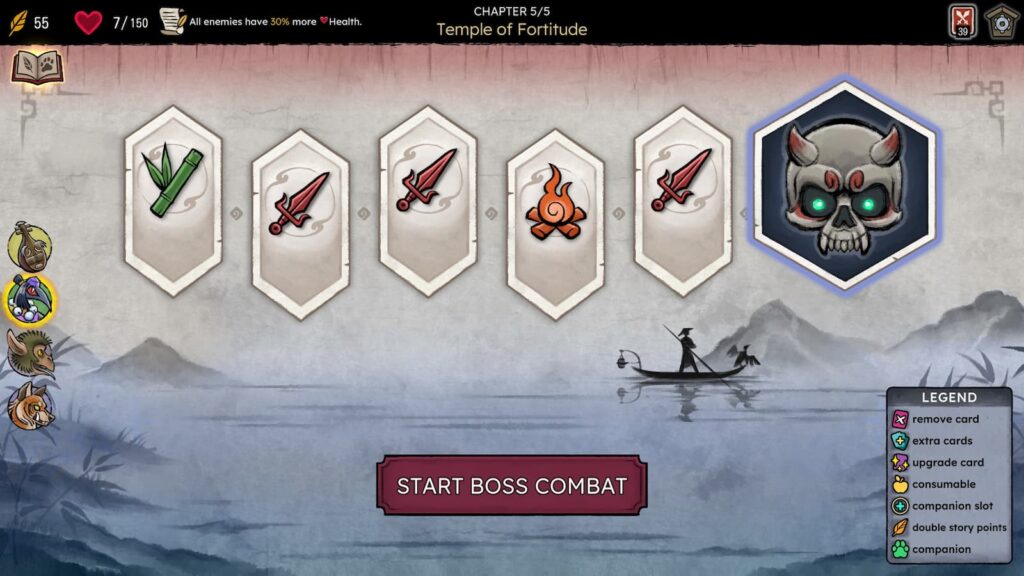
The stage/run structure of Talespinner is an interesting one. Each stage consists of 6 different nodes, with the player being able to select what will appear in said nodes. They can be a battle, a very tough battle, a random event, or a campfire to heal 30% of your HP.
While the player will be able to select what will happen during the next node, your choices will be limited. There will be two free options that you can place on the next node, with any other option requiring payment. The player is consistently put in the position of wondering if they should pay for a better battle or save that money for cards or card upgrades in the stage’s shop.
After each stage of a Talespinner run, the player will have two choices for which stage they will play through next. One stage will inflict debuffs upon the player during each battle while the other will inflict no debuffs. A player might suspect that playing through the stage that inflicts debuffs will result in greater rewards to balance the risk, but shockingly it doesn’t work that way.
The game displays the rewards each stage grants while you make your choice, and bizarrely it seems that the reward pool for the debuff stages is the exact same as the normal ones; in fact, sometimes the rewards on the non-debuff stages were better for my runs as I tend to prioritize paths where I either obtain companions or upgrade cards.
Because of this, I have no idea why a player would ever select the version of the stage which gives you debuffs. The game is already difficult enough and can put the player in unwinnable situations on a whim; adding something extra on top of that is a form of torture that I cannot see myself opting into outside of sheer curiosity.
Whenever the player completes a battle, they’ll be given a random card from a choice of three. At this point in the review, you may be starting to notice exactly how many random elements are beginning to pile up. The cards you play each turn are randomized, the contents you can choose for each node are randomized, the buffs/debuffs a stage can give you are a randomized choice, and the rewards for each battle are randomized.
From start to finish, the player will always be rolling the dice on whether or not they’ll survive the next few minutes of their run in Talespinner. While this can create a feeling of euphoria when the player gets very lucky and obtains plenty of useful cards/companions, it can also feel spirit-crushing when a run ends not because of any mistake the player made, but because the RNG just wasn’t in your favor that run.
A Lack of Content
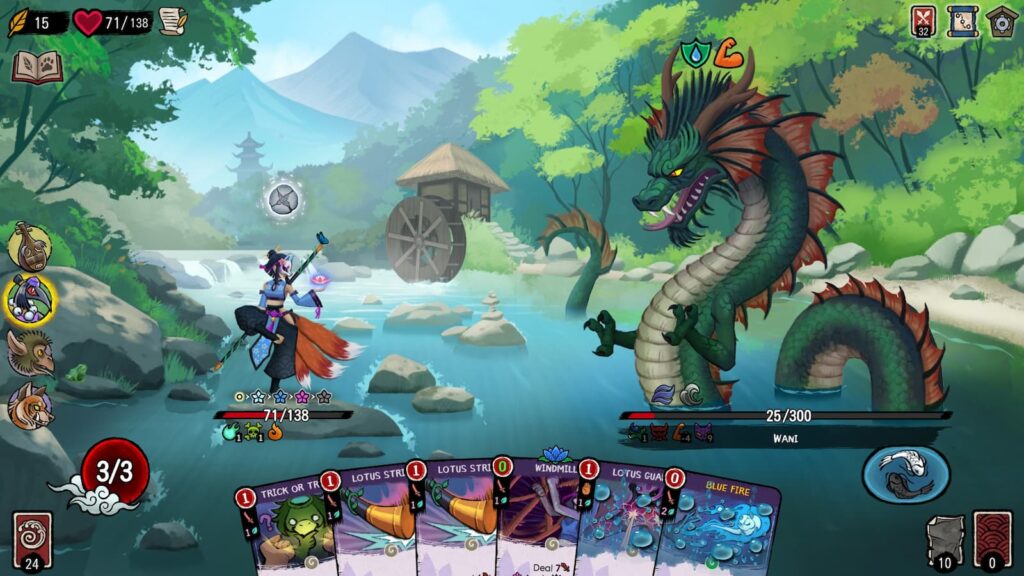
Unfortunately, Talespinner does suffer from a lack of content. The game features three different difficulties, with the first being three stages long, the second being five stages long, and the third being seven stages long.
The first few stages are the same across all three difficulties, creating an undeniable sense of repetition when the player is fighting their way through the rice fields for the dozenth time. When so many runs in this game are ended by pure RNG, it’s hard not to desire more.
By the time the player has bumbled their way through enough failed runs to reach the end, the player will see everything the game has to offer (barring some skills and companions which spawn rarer than others). While this can feel a bit nice as the game won’t be able to surprise you with an enemy you don’t know how to handle late in your run, it does make the times you do fail all the more frustrating as you know you’ll need to play through the same content again.
I understand that this is the nature of all roguelikes, but it is still an element of Talespinner which grew to annoy me the longer I stuck with the game and grinded my way toward the end.
Good Visuals
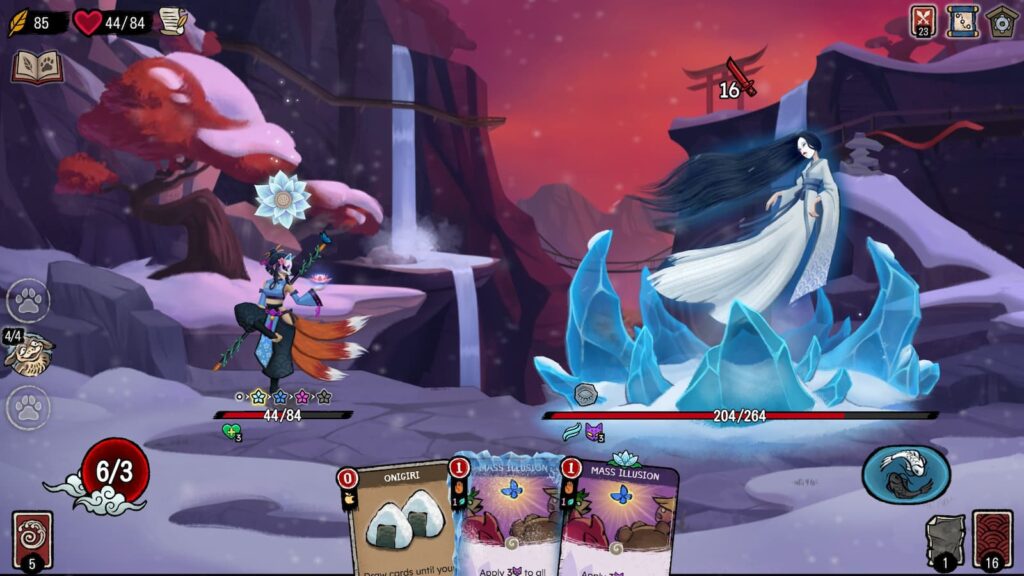
Visually, I think Talespinner is a great-looking game. The art for the three playable characters, the various enemies you’ll face, and the visuals of the cards you play are all fantastic and pull from various pieces of Japanese folklore.
If there is any flaw in the game’s visuals, it’s that each character has only a single attack animation that doesn’t change no matter what cards you play; however, that’s a minor complaint as attacking in this game takes only half a second at most due to the fast-paced nature of battles.
While I greatly enjoy the visuals and aesthetics of Talespinner, the game’s complete lack of any story content feels very odd. When your currency is story points, and the various limitations you can put on your runs are called ‘Plot Twists’, not having an actual story to go alongside your runs sticks out as strange.
Closing Thoughts
Overall, I enjoyed my time with Talespinner but did find myself longing for the game to do more. The battles in this game are undeniably interesting, and I had fun with them, but the randomness of the game’s roguelike structure made it feel like I was never able to take full advantage of my abilities and made needing to restart from the first two stages repeatedly all the more frustrating. However, despite these gripes of mine, I would still recommend this title to anyone interested in a short roguelike with an interesting battle system unlike most others in the genre.
Talespinner
Bottom Line
Talespinner is a game with an interesting concept with a mixed execution. While the combat and deck building elements of the game shine through and will keep nearly any gamer engaged, the rogue-like elements fall short due to the game's lack of variety outside of the deck building. Despite its flaws, the overall experience is still enjoyable and is sure to satisfy gamers looking for a short yet fun rogue-like in this style.