
Want to see Raider King content first? Add us as a preferred source.
A small Steam idle game about running a burger stand has become an unlikely window into one of the most lucrative and least understood problems facing Western indie developers today: how China’s booming mobile gaming ecosystem, worth tens of billions of dollars annually, can simultaneously offer enormous upside and near-total exposure to unauthorized cloning, with very few developers equipped to fight back.
China’s gaming market is one of the largest in the world. The country’s domestic gaming market generated 350.8 billion yuan (roughly $49.8 billion) in 2025, up 7.7% from the previous year and a new all-time record, according to data from China’s semi-official gaming industry association. Newzoo projected China will overtake the United States in 2025 to become the single largest video game market on the planet by total sales, with the country’s gamer population now at 683 million people, a number roughly double the entire population of the United States.
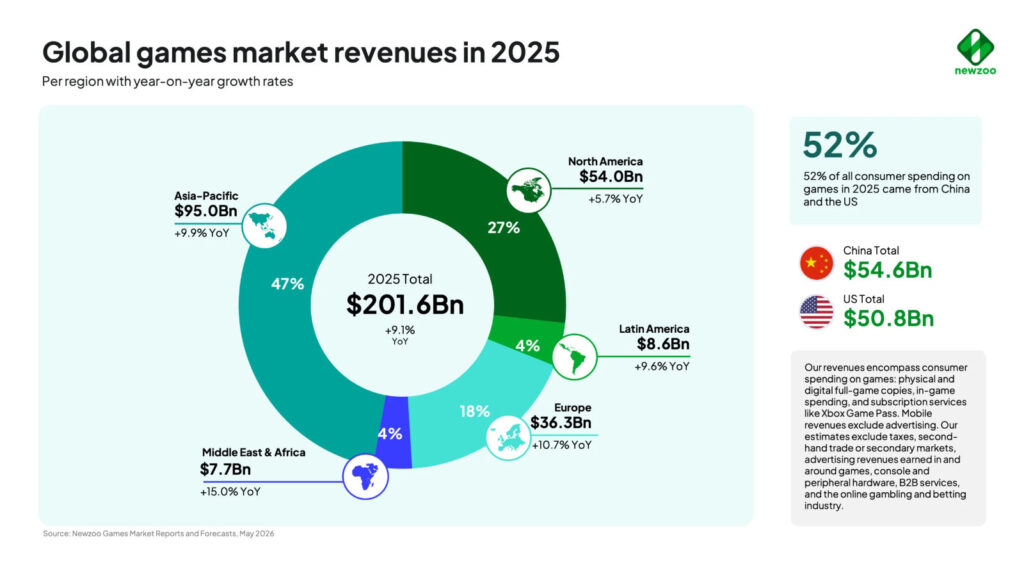
Mobile gaming dominates that market overwhelmingly, accounting for 73.3% of total revenue, or about 257 billion yuan, while PC gaming holds a 22.3% share. For a Western developer whose game gains organic traction in China, even a modest slice of that market can dwarf domestic Steam sales, which is precisely the dynamic playing out in the case at the center of this story.
Douyin, the Chinese domestic version of TikTok, run by the same parent company, ByteDance, has evolved well beyond short-form video. Its “mini-game” ecosystem allows users to play fully functional games directly inside the Douyin app, with no download or app store visit required, similar in concept to how Netflix hosts games inside its own app or how Roblox hosts user-made experiences inside its platform.
This is not a fringe feature. According to the 2026 Douyin Mini-Game Industry White Paper, daily active users of Douyin’s mini-game platform exceeded 100 million by the end of 2025, with monthly active users around 600 million, a figure expected to approach 700 million in 2026. More than 81% of that traffic comes from within Douyin’s own ecosystem, through private messages and social sharing, rather than external promotion. In other words, once a mini-game is published on Douyin, it doesn’t need marketing. The platform’s built-in social mechanics can hand it an enormous audience within days.
That same frictionless distribution model, however, is what makes it structurally vulnerable to abuse. A cloned game requires no installation, no app store review comparable to Apple’s or Google’s, and can be shared instantly through a platform already embedded in hundreds of millions of phones.
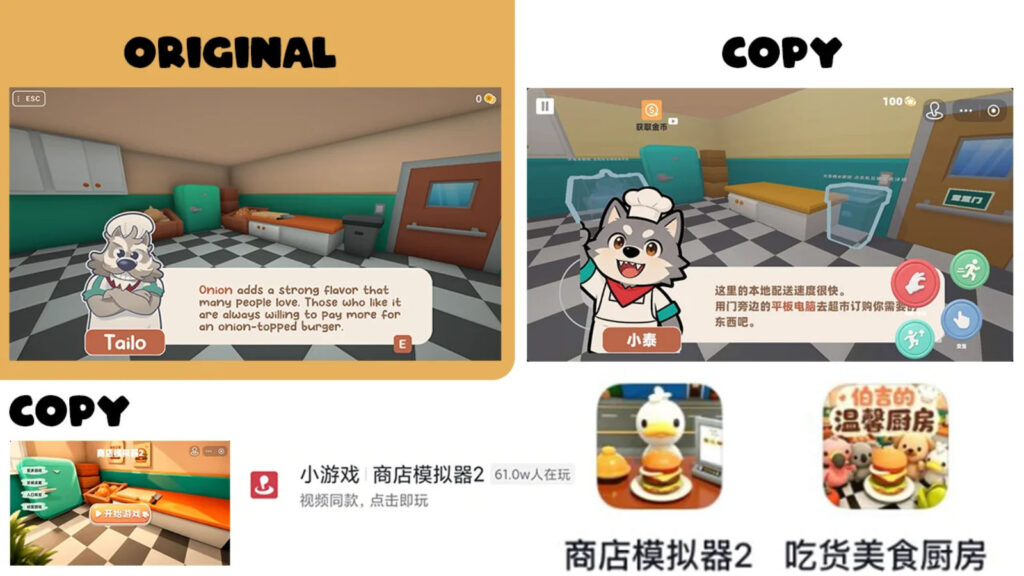
Burgie’s Cozy Kitchen, a cozy burger-management idle game from Spanish solo developer HeyNau, entered Steam Early Access in 2025. After a demo release drew attention from Chinese content creators on Douyin, the game experienced a surge in visibility and, almost simultaneously, a surge in unauthorized clones circulating on the same platform, including a mobile version the developer says he never built.
The pirated version’s spread became part of the public conversation around the game almost by accident. According to HeyNau’s own account, posted on the r/gamedev subreddit, players who had picked up the pirated Douyin mini-game began noticing something odd after roughly an hour of play: customers in the restaurant started dressing as pirates, tipping a single coin, and leaving complaints like “Pirates don’t leave tips,” all while an accordion-remixed version of the game’s soundtrack played in the background. Believing this to be a bug rather than a deliberate anti-piracy mechanic, confused players took to comment sections and Steam reviews to complain, prompting HeyNau to personally explain what was actually happening. That explanation reportedly spread organically across Chinese social media, with users correcting each other whenever the “bug” came up, effectively turning the developer’s joke mechanic into an informal, crowd-sourced way of telling the legitimate version apart from the clone.

By late June 2026, the cloned version, listed on Douyin’s own mini-game store under an entirely different name, “商店模拟器2” (“Store Simulator 2”), had reportedly reached over 600,000 players, according to the developer. That figure, if accurate, likely exceeds his total legitimate Steam player base many times over. HeyNau has also said the anti-piracy mechanic bought him roughly one to two weeks before the clone’s operators identified the cause of the “pirate customer” glitches and disabled the trigger in their build. A detail that, notably, only surfaced because so many confused players were already discussing it in public.
This is not an isolated case. A separate, independently filed complaint on the same r/gamedev forum, posted weeks earlier and unconnected to the Burgie’s situation, describes an entirely different unreleased indie title being stolen wholesale and republished as a Douyin mini-game using the original developer’s actual assets. Two unrelated developers reporting functionally identical failure modes (original work appearing on Douyin’s storefront without authorization, discovered largely through player complaints rather than platform enforcement) points toward a systemic gap in the platform’s vetting pipeline rather than a one-off incident.
Here is the detail most Western developers get wrong: China’s courts are not the hostile, unwinnable environment they’re often assumed to be for foreign software copyright holders.
A comprehensive analysis by Rouse and the CIELA intellectual property litigation database, which tracked every published software copyright case in China’s civil courts from 2010 to 2019, found that foreign plaintiffs won 85.3% of the 285 first-instance software piracy cases they filed against domestic Chinese defendants. That win rate held up on appeal too: of foreign plaintiffs who won at first instance, only 4% saw the ruling fully overturned on appeal, while 88% of first-instance wins were either upheld outright or upheld with only a compensation adjustment.
Compensation, when awarded, was also substantial by Chinese court standards. Foreign plaintiffs received a mean award of roughly CNY 501,195 (about USD 69,600), nearly 13 times higher than the median compensation awarded to domestic Chinese plaintiffs in equivalent cases. The very top awards were dramatically larger. The highest single judgment in the dataset topped CNY 20 million (roughly USD 2.9 million), awarded to French software company Dassault Systèmes against a Chinese engineering firm. Companies that filed selectively and built strong evidence, including Microsoft, Siemens, Autodesk, and Dassault Systèmes, achieved 100% win rates, while companies that pursued cheap, high-volume “bulk litigation” against many small infringers simultaneously saw their win rates drop meaningfully. Rhino Software, the most prolific foreign filer with 113 cases, won only 73.5% of them.
Cases also move fast by international standards. Foreign-related software piracy cases took an average of just 9.1 months to resolve at first instance, with appeals adding roughly 5.3 months when pursued. And crucially, the data shows no evidence Chinese courts favor domestic defendants for nationalistic reasons, foreign plaintiffs won at nearly identical rates whether suing state-owned enterprises (85.7%), foreign-invested joint ventures (87.2%), or ordinary domestic private companies (84.9%).
The catch, and it’s a significant one, is that this 85% win rate applies almost entirely to enterprise software plaintiffs, companies like Microsoft, Autodesk, and Siemens suing corporate end-users for using unlicensed engineering, design, or productivity software internally. That is a fundamentally different legal and evidentiary scenario than an indie developer trying to stop a mobile game clone being distributed for free, ad-supported play to consumers through a social media platform.
The report’s own analysis identifies evidence-gathering as the single biggest determinant of case outcomes. Nearly every foreign plaintiff loss in the dataset traced back to insufficient proof of infringement. Chinese civil procedure has no U.S.-style discovery process, meaning plaintiffs must independently gather their own evidence, typically through notarized undercover investigations or court-ordered Evidence Preservation Orders, which require the plaintiff to already present a credible prima facie case before a judge will even authorize a search. For enterprise plaintiffs, that means sending investigators into a factory to photograph pirated CAD software running on office computers. For a solo indie developer facing a mini-game clone on Douyin, the infringement is arguably easier to document, screenshots and public player counts are visible to anyone, but the practical machinery of filing a Chinese lawsuit, securing local counsel, and navigating a system built around domestic entities remains a steep barrier.
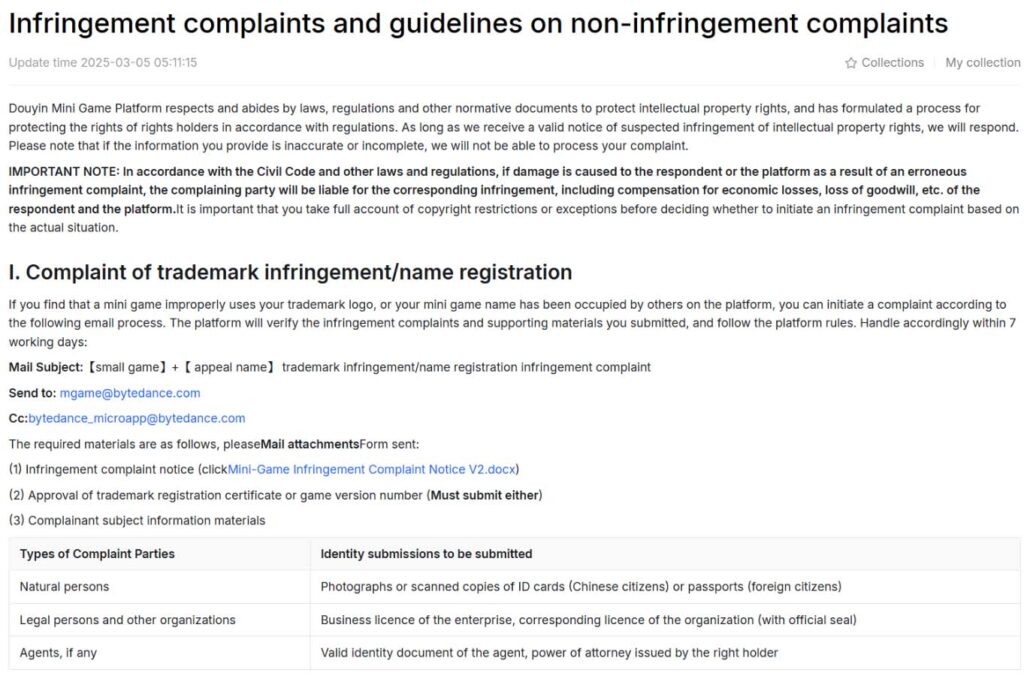
That barrier starts even before litigation: Douyin’s own developer platform requires a Chinese national ID to register a full account, effectively locking foreign individual developers out of the platform’s fastest internal enforcement channels and leaving them dependent on email-based infringement complaints, which Douyin’s public policy states it will act on within seven business days of a valid notice.
Piracy of Western games in China isn’t new, but the venue has shifted. Software piracy in China has historically involved installing cracked programs on individual machines, the exact scenario the CIELA data was built to measure. Douyin’s mini-game format represents a newer and arguably more scalable version of the same problem: rather than pirating one copy at a time, a bad actor can clone a game once and distribute it instantly to a built-in audience of hundreds of millions, monetizing through advertising rather than sales, with no purchase step for the platform to police.
The legal precedent is genuinely favorable for the developers willing and able to pursue it, an 85% win rate and multi-million-yuan awards in the best cases are not trivial numbers. But that precedent was built by companies like Dassault Systèmes and Microsoft, with in-house legal teams, established Chinese counsel, and the resources to conduct notarized investigations. Whether that same legal machinery is realistically accessible to a solo developer overseas, watching player counts climb on a platform he can’t even fully register an account on, remains the open question this case leaves unanswered and likely the reason so many similar clones on Douyin’s mini-game storefront go unchallenged.


