
Want to see Raider King content first? Add us as a preferred source.
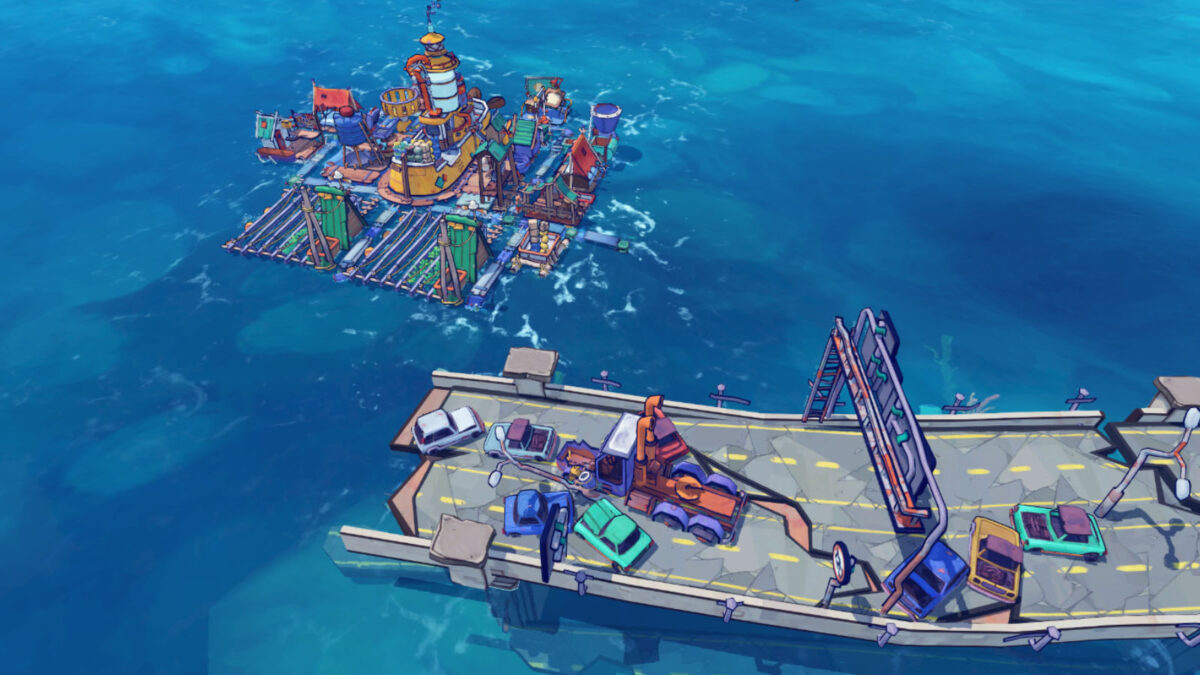
Flotsam is one of those city-builders that looks like it started life as a doodle in the margins of a notebook: a little floating town cobbled together from trash, drifting across an endless sea after the world has quite literally gone under. It has been around since 2019 in early access, quietly gathering a small but loyal audience, and that long road makes its 1.0 release feel like a genuine milestone for players who have been there from the start. There is a clear sense that this is a long-gestating passion project, and that shows most in what the game chooses to focus on. And, just as importantly, what it refuses to.
Instead of leaning into grim scarcity or post-apocalyptic despair, Flotsam doubles down on something much rarer in the survival-builder space: optimism. Your survivors pick through a choked and polluted ocean, yes, but the game refuses to let that be the emotional anchor. It starts “after,” with the catastrophe already baked into the setting, and then gently pivots to a tone about community, cooperation, and making progress together despite the mess left behind. The backdrop is humanity’s failed responsibility to the planet. The mood is about our capacity to do better. It even manages to touch on that environmental conversation without sermonizing, using a light, hopeful touch that leaves you feeling weirdly positive by the time you’re done.
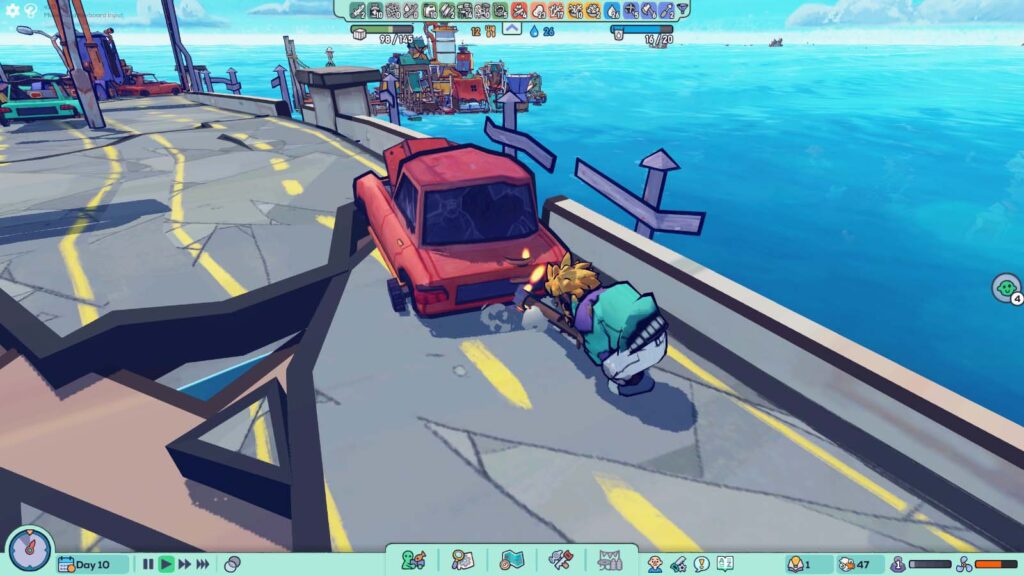
That tonal choice is reinforced everywhere. This is a survival colony builder with no combat at all, which already sets it apart from a lot of disaster-themed management games. The art style is bright and whimsical, with a “quirky and cutie” cast of survivors who make the whole enterprise feel more like a charming storybook than a grueling test of endurance. Character portraits are pleasant, the in-game graphics are clean and readable, and the whole thing has that slightly offbeat, handmade feel that fits the idea of a floating town lashed together from scrap. Even the seagulls get in on the charm offensive: you can befriend them, there are quests built around rescuing them, and they end up feeling like minor but memorable residents of your drifting community.
The people themselves do a lot of heavy lifting in making the town feel alive. Rather than anonymous worker slots, they come with little bits of lore, flavor, and personality that make them feel like actual members of the community instead of mobile resource nodes. Their quirks, styles, likes, and strengths turn each new rescued survivor into a small event. That structure supports the game’s hopeful tone nicely: there’s genuine satisfaction in watching a ragged handful of drifters turn into a bustling, slightly ridiculous floating town where everyone has a place.
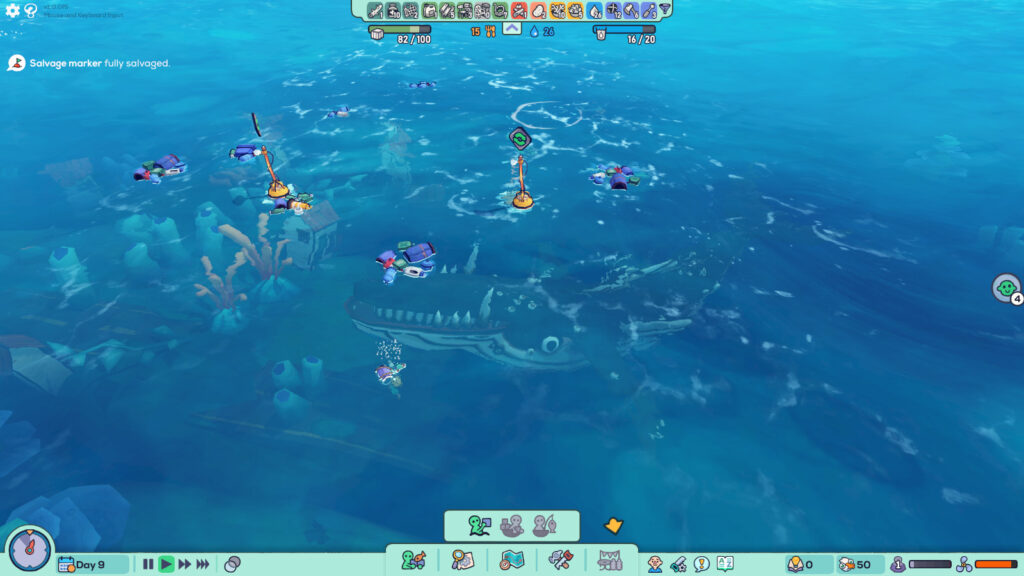
As a pick-up-and-play experience, Flotsam is deliberately approachable. The game is something relaxing to sink into when you want the pleasure of building and optimizing without diving into a fiendishly complicated simulation. It’s absolutely possible to hit real challenges though, especially if you’re not paying careful attention to resources, but a lot of the time the game settles into a kind of chilled-out rhythm. For anyone hunting for a “cute tiny colony/builder game” that doesn’t demand a spreadsheet and a second monitor, Flotsam fits the bill.
At the core is a straightforward but satisfying loop. You start with a tiny floating settlement and sail it across different regions of the flooded world, scavenging what you can from the ruins and expanding as you unlock new technologies. Each region has its own selection of landmarks, resources, and considerations, which keeps exploration from feeling like you’re endlessly trawling identical trash piles. That structure also feeds into the sense of curiosity that runs through the game: there’s a constant, low-key thrill in wondering what’s just beyond the next stretch of ocean and how it might help (or complicate) your plans.
The ability to directly move your floating town around the map underpins a lot of the game’s personality. You are not rooted in place like a traditional city-builder, you’re captaining a “floating paradise” that grows more impressive and capable as you climb the tech tree. Early on, your range and options are limited, but as new techs come around, your reach expands in ways that feel meaningful. You can approach different regions with slightly different plans and priorities, and the game gives you enough control over pathing that your journey feels authored rather than purely reactive. There is a simple but satisfying pleasure in looking at your weird, ungainly town, bits and pieces jutting out over the water, and knowing you’ve steered it across an entire ruined world.
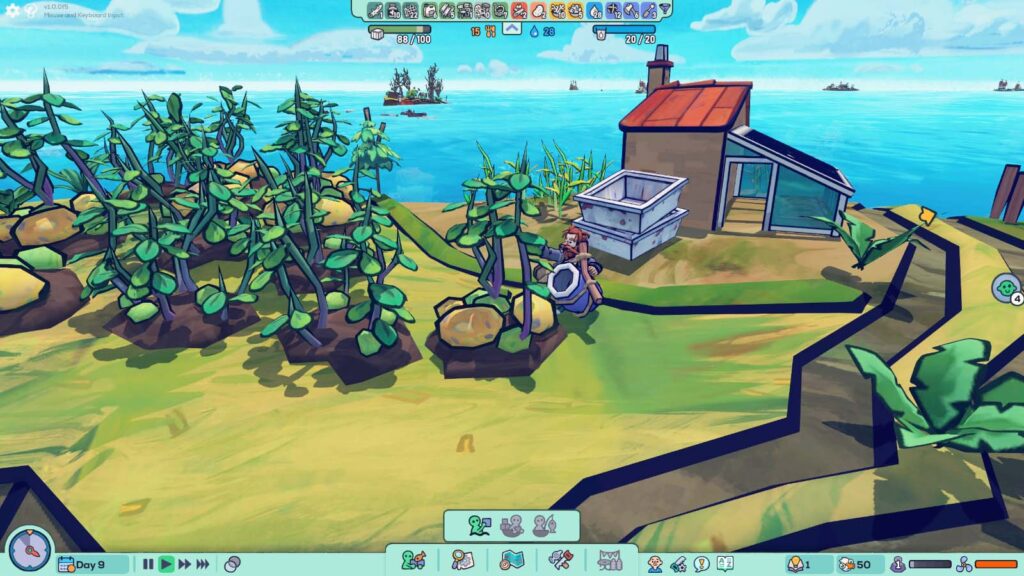
Layered on top of this is a short, focused story that plays out over your journey. It stays short and sweet, offering just enough narrative structure to keep you pointed toward broad goals without drowning the management side in exposition. The post-flood world and its pollution-heavy imagery set the scene, but the writing keeps circling back to that central thread of hope, of building something better together out of the debris of past mistakes. For a genre that often sidelines storytelling in favor of pure systems, it is notable that players call out Flotsam’s narrative as “interesting” and emotionally resonant.
All of that is the good news, and for a lot of players, it is more than enough to justify drifting off into Flotsam’s waters. Underneath that charm, though, is a game that can feel like it is still shaking off its early access habits, even in its 1.0 form. The systems have good bones, especially when it comes to resource management, but there are some persistent structural and quality-of-life issues that keep it from fully realizing its potential.
Production is the first place where the cracks show. Flotsam stitches together a bunch of familiar mechanics from other builders into a generally satisfying whole, but it stops short of giving you the kind of fine-grained control that has become standard in the genre. At production buildings, your options are usually to craft a fixed number of items or to set a recipe to run infinitely. What’s missing is the middle ground: something like “keep making this until there are 20 in storage.” That single kind of rule, “maintain X in stock,” is the difference between a resource system that hums along in the background and one that demands constant fiddling.
The mechanic seems to be in there, but I’m not sure if I’m just incompetent and I’m not using it properly, or if it works differently from the way I expect it to. I set the lower range to, let’s say, 10 meals, and I end up with 15 meals somehow. Either it ignores how many you already have in storage, or I’m just bad at figuring out an extremely easy mechanic.
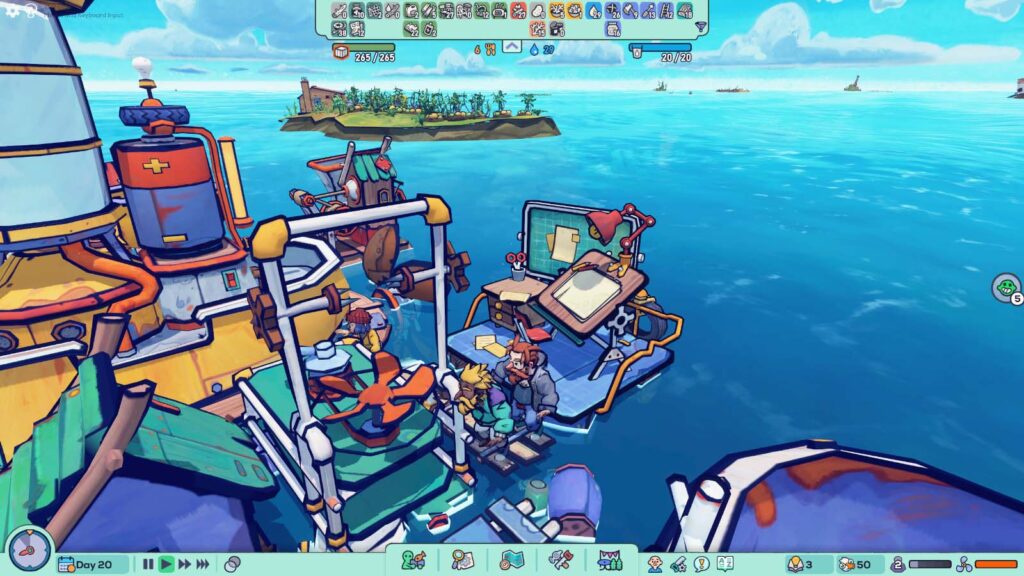
The way workers are handled feeds into the same sense of friction. Once your town population climbs to around 20 people, you can end up with a surprising number of idle workers, and the game does little to help you understand why. Other management titles often go out of their way to surface idleness as useful information (popping up alerts or lists of citizens with nothing to do) because an idle worker usually means a gap in your planning or infrastructure. Flotsam, by contrast, quietly lets people “stare off into the ocean” without drawing your attention. I really didn’t see much reason to push population beyond that point, aside from chasing an achievement for having 25 residents. It’s a small design choice, but one that reinforces the feeling that the game never quite gives you the tools to see and tune your town as clearly as you might want.
Pacing in the second half of the game can compound these issues. From the mid-game on, progress through the tech tree depends heavily on finding specific people scattered across the map, about eleven of them, who act as gates to new technologies. The tree itself isn’t particularly large, and some of those key individuals unlock only a single tech. In practice, that means stretches of play can feel less like you’re organically evolving your town and more like you’re ticking off required map nodes in order to push a fairly modest upgrade path forward. The overall experience feels drawn out and padded, with the hunt for those individuals and certain late-game resources turning into extended slogs rather than satisfying arcs.
Those pacing problems become especially noticeable toward the end of the story. At one point, completing a main objective hinges on building a device that needs a relatively rare resource: aluminum. Without a clear pointer to where that resource can be found, I spent an hour trudging the boat in one direction, hoping the game would finally spawn the right landmark. Of course, this could very likely just be a skill-issue on my side.
Earlier in the game, a similar issue crops up with a seagull-related quest: sometimes the game is good about pointing you to the nearest point of interest when a quest step needs it, but in this case, no such guidance appeared. It’s not that searching is inherently bad, especially in a game about drifting exploration, but the line between “adventure” and “time-wasting” is thin, and Flotsam crosses it more often than it should.
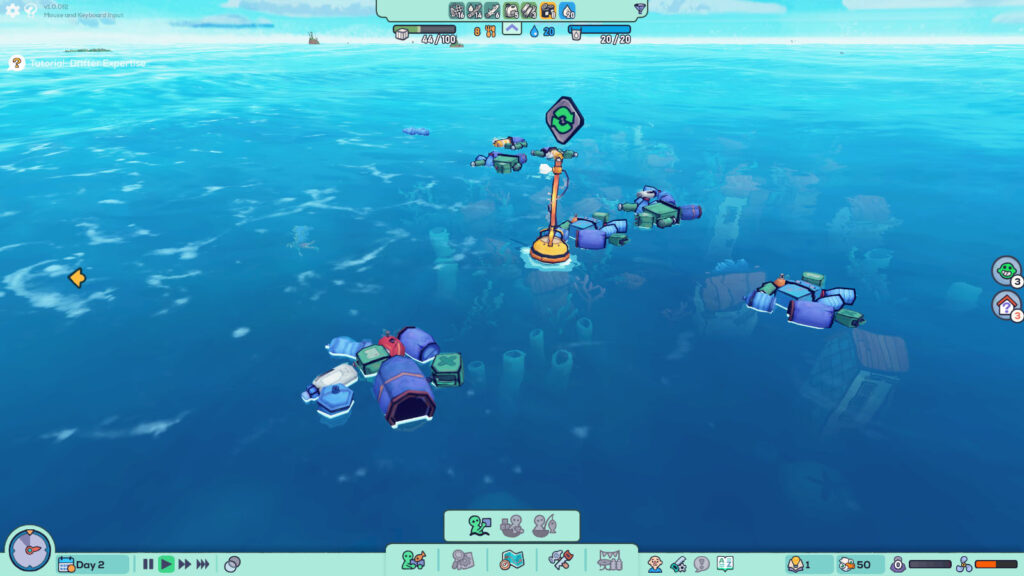
Even the finale doesn’t entirely escape that sense of drag. As the credits roll and the main story wraps up, you are put into a slow, semi-interactive sequence where you have to pedal your boat along a long path with the credits in the background. The intention is clear: a reflective, cinematic exit from the post-flood journey you’ve been on. But when a player already feels like the game has overstayed its welcome, that slow-roll ending becomes one more thing to push through before uninstalling.
Navigation and building layout introduce another layer of friction. The promotional footage on the store page emphasizes big, sprawling floating towns, with structures jutting out in all directions, a fantasy that players absolutely will try to live out. The problem is that the map design doesn’t always cooperate. Protruding parts of your town can bump into terrain as you attempt to weave through tighter areas, and there often isn’t quite as much maneuvering room as the fantasy of an ever-expanding scrap-city implies. Steering itself can be finicky: grabbing the front of the ship to drag it forward only works reliably about half the time, while the other half the game interprets the interaction as steering from the back, flipping the boat around and sending it backward. None of this is game-breaking, but it turns something that should be smooth and playful into an occasional annoyance.
Architect mode is a perfect microcosm of Flotsam’s strengths and weaknesses. On paper, it’s a delightful idea: a dedicated mode that lets you rebuild and redesign your town layout to your liking, reshaping your floating community without having to demolish and reconstruct everything piece by piece. In practice, at least in some cases, it can be heartbreakingly buggy. At one point I spent around half an hour carefully redesigning the entire town, only for the game to insist there was still “one item” left to place. Which one? No idea. The only way out was to revert every single change and lose all that work. That sort of failure doesn’t just cost time, it shatters the cozy, relaxed mood the game otherwise works hard to create. It’s the kind of experience that can kill enjoyment right then and there, and it understandably left me with a bitter taste in my mouth.
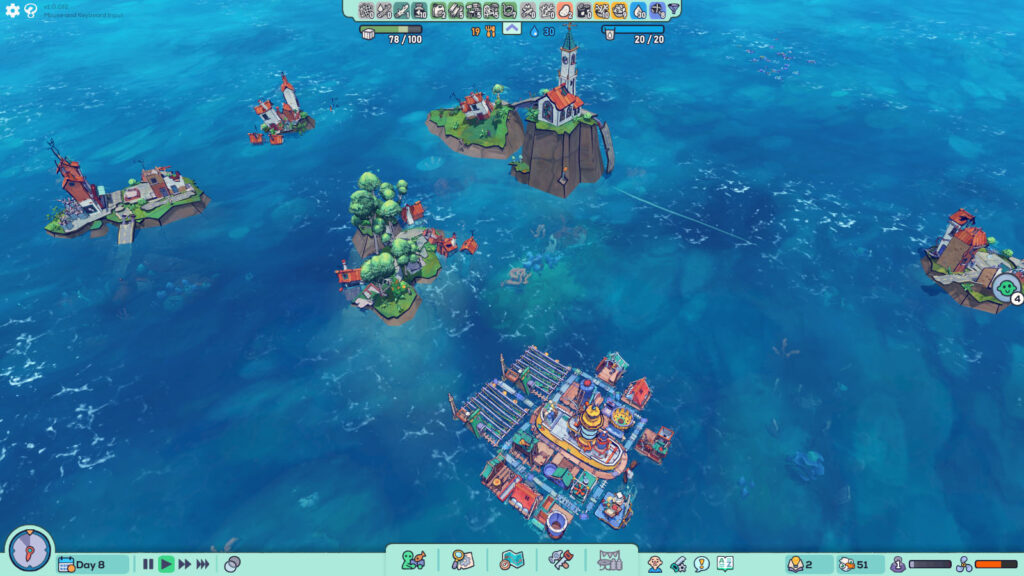
Bugs crop up in other, smaller but persistent ways. Characters can occasionally get stuck in loops, endlessly trying to go to school, plant something, or perform some other task while neglecting food, water, and sleep for in-game days. Sometimes a straightforward save-and-reload clears the issue, sometimes you have to quit to desktop and reload. The quest system, as mentioned, also feels inconsistent: occasionally helpful with pointing you to the next step, occasionally leaving you to flounder. Taken together, these issues contribute to that nagging sense that, despite the version number, the game still doesn’t feel finished.
And yet, there is something special here. The music is a plus, supporting the game’s relaxing, hopeful mood. The general gameplay, this blend of familiar mechanics into a nice combination that feels satisfying for the most part. Performance is solid, with no notable FPS drops or crashes, which means the technical roughness is more about systems and bugs than outright instability. For those who connect with its mood and pacing, Flotsam can be genuinely addictive, with just enough challenge to keep you engaged so long as you remain at least somewhat careful with your planning.
In the end, Flotsam sits in an interesting place. It is a game with a strong identity: a hopeful, post-flood survival builder where the focus is on community, cozy exploration, and turning trash into something beautiful, rather than scraping through a hostile wasteland. Its characters are charming, its world is visually appealing, and its soundtrack and performance support rather than undermine the fantasy. At the same time, it’s a game where the late-game pacing, missing quality-of-life tools, and lingering bugs will absolutely matter to some players.
If you come in wanting a perfectly tuned, deeply automated, endlessly replayable city-builder, Flotsam is going to feel shallow in spots and rough around the edges. But if what you’re looking for is something cute, hopeful, and not too complex, with seagulls to befriend and a small community to shepherd across a ruined ocean, then there is a genuinely enjoyable, comfort-food experience here. As long as you’re willing to accept some micromanagement, occasional quest hunting, and the odd bug-induced reload, Flotsam can absolutely earn its spot as a cozy, charming oddity on a very crowded strategy shelf.
Flotsam


