
Want to see Raider King content first? Add us as a preferred source.
On October 21, 2026, GPTRACK50 will be releasing Stupid Never Dies, an action roguelike where the player will take control of a young zombie named Davy as they fight for love and eat their way to the bottom of a constantly expanding dungeon. This game promises stylish action, where the player grows stronger every run as they eat their way through every enemy standing between them and their true love. So, is this game worth playing or should gamers chow down on another meal? Let’s dissect Stupid Never Dies piece by piece and make the decision for ourselves.
Stylish Action
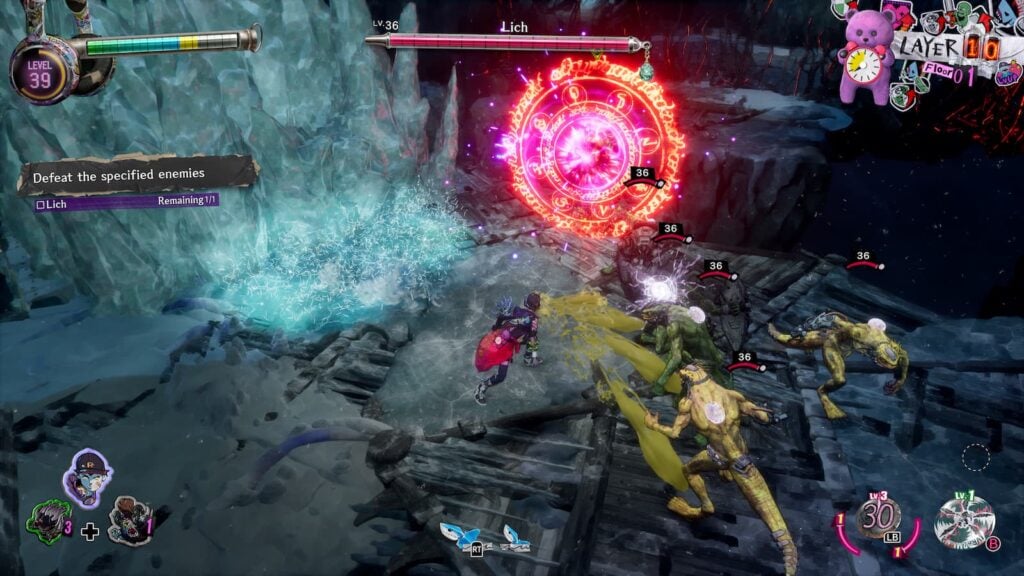
The combat of Stupid Never Dies at a first glance appears to be a normal action game. The player, as Davy’s zombie form, will have access to a basic light attack, heavy attack, a few special moves that are determined based on the items you have equipped, and of course a bit button. Davy’s attacks appear slow, but they pack a real punch that allow him to do great damage to enemies that match his level.
The true highlight of Stupid Never Dies’ gameplay is the Style Eat mechanic. Whenever the player defeats an enemy that isn’t one of the weak fodder ones, you’ll be able to absorb their style and transform into them by tapping the left or right buttons on your D-Pad.
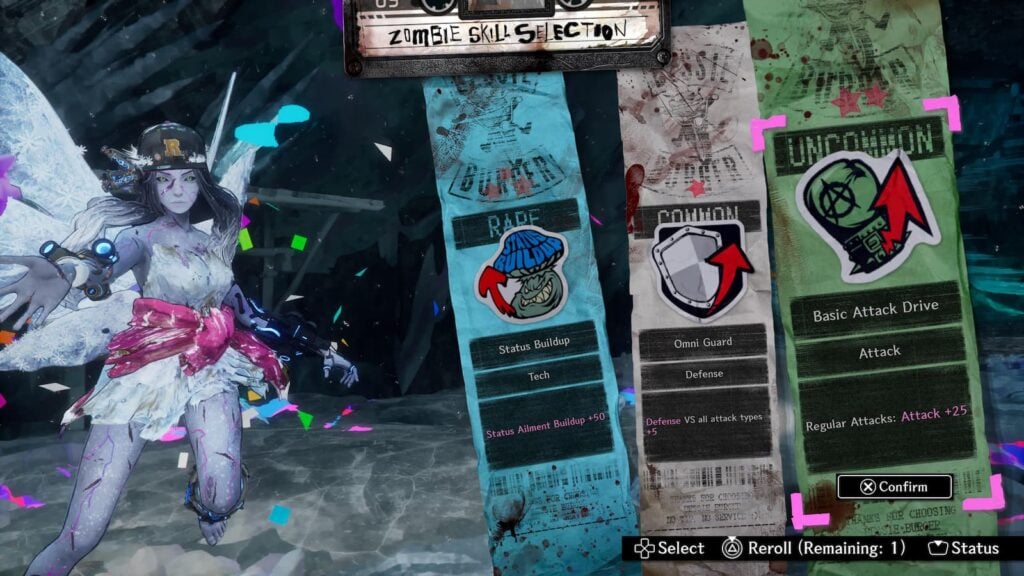
In an instant, Davy can become a towering colossus whose attacks are extremely slow but have immense power and knockback ability, or you can become an ice fairy with quick attacks that slowly build up a freeze meter, which can lock enemies in place to allow you to do massive damage.
These enemy styles come with their own attacks and passive buffs to your base stats as well. So even if you’re not planning to transform into one for your current fight, it’s best to eat as much as you can anyway in order to become stronger.

The strength of each style you absorb depends on the strength of the enemy you took it from. Sometimes you’ll eat a weak werewolf and get a weak version of the werewolf style in turn, which only has a basic attack and next to no buffs, or you’ll get extremely lucky and encounter an incredibly strong werewolf that will let you wipe out groups of enemies with ease.
Style Eating has one major downside, however: You only have access to each style for 3 floors of the dungeon. Even if you don’t transform into them, the style will vanish after you have progressed three floors. This creates a very satisfying loop where the player is constantly switching into new styles and eating many enemies to gain different transformations every few minutes.
The limited amount of time you have access to each style may sound like a nuisance at first, but it results in something I love: Encouragement of reckless play. Whenever you clear a floor in Stupid Never Dies, you have the option to either travel to the next floor that’s only a slightly higher level than the one you’re on or jump down multiple higher-level floors in order to complete your run quicker.
If I have no strong styles currently absorbed, I tend to play it safe and only move on to floors that are the same level as mine. However, if I have a particularly strong style such as a harpy one with the ability to deal massive damage from a distance, then I’ll gladly travel down to a boss floor that is many levels above me to test my skills and see if I can cut multiple minutes off my run time.
A Roguelike To Die For
Now that we’ve gone over the base gameplay and combat mechanics of Stupid Never Dies, let’s take a few minutes to look over the game’s roguelike mechanics and the gameplay loop which makes this game really stand out amongst other games in the same genre.
You’ll likely have noticed that during my praise of Stupid Never Dies’ gameplay, I put quite a heavy emphasis on how much time actions take and how you’ll want to style-eat enemies so you can clear floors faster. That’s because this game has a time limit that is always counting down whenever you’re in a dungeon.
Each time you challenge the dungeon, you’ll only have a few minutes to clear it. If your timer runs out, you’ll immediately begin to take a huge amount of passive damage and die within seconds. So make sure you rush through each floor as quickly as you can.
There are ways to mitigate the game’s time limit, of course. Every ten layers you clear in the dungeon will give you an extra 3:00 of time, further encouraging you to skip as many layers as you can to speed toward the end. If that isn’t enough, each layer also has a reward chest at the end, and one of these rewards is an extra minute of time.
Losing a run because you run out of time is honestly something that rarely happens, as long as you’re always moving forward, of course, but the mere presence of the timer and knowing that there is an ever-looming threat makes for great motivation to always rush through each room at high speeds and consider if you really should be killing every enemy for the EXP.
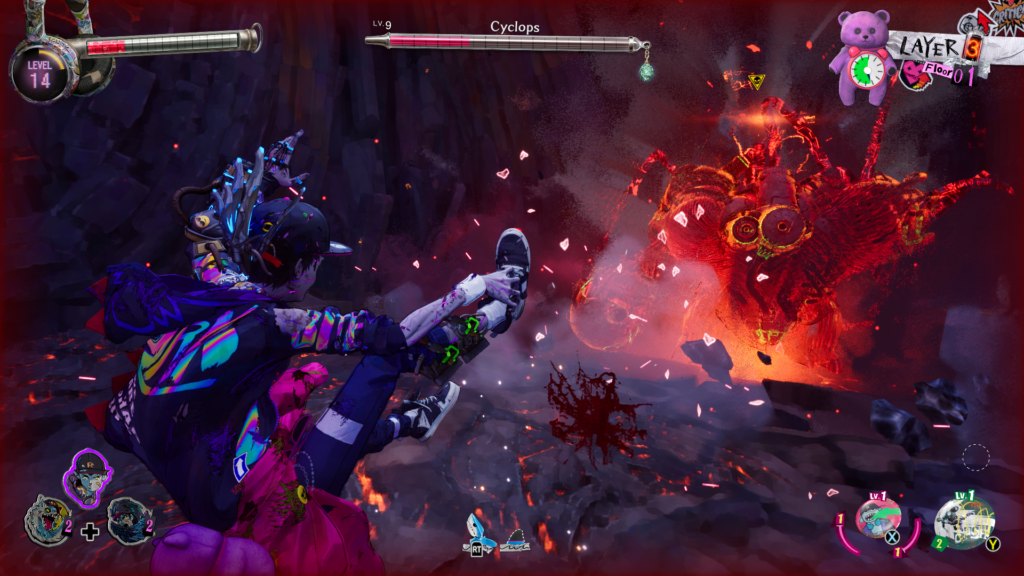
Grabbing that EXP will always be tempting though, as not only will leveling up make your current run go by easier, but it will also make you stronger in all future attempts thanks to the game’s incredibly intriguing level-up system.
Every time you lose a run in Stupid Never Dies, the game will save a record of how much EXP you earned during that run. Every future run will give you a boost in EXP matching your failed run. An enemy that only gave you, say, 1 EXP during your first run will be giving you 100 EXP by your fifth run.
Davy is an immortal zombie; losing a run is never the end of the world, as you’ll always be growing stronger. It might be discouraging to lose to a boss after spending 10-20 minutes running down to his lair in order to bite him, but knowing that the next time you attempt to fight him you’ll likely be a handful of levels stronger than you were last time has an entrancing effect that makes you want to try again immediately.
After every other level up, the player will have to choose between three different upgrades. If you have played nearly any game released within the past two years, you likely understand how this system works. Some upgrades are passive buffs, like increasing the amount of damage done to bosses, while others are more drastic changes, like switching the active skills in Davy’s zombie form to different ones.
It is no secret that I am generally not a fan of roguelikes, as multiple reviews I have put out this year have showcased that I can be a bit harsh on the genre due to my dislike of the random chance mechanics that tend to make or break runs in these games. Despite that, I really enjoyed the gameplay loop of Stupid Never Dies.
Yes, the game does rely on the same random chance to complete runs that most other games in this genre do, but having it be tied to level-ups when one of the game’s largest mechanics is raising the speed at which you level up leads to an interesting scenario.
Instead of waiting until you’ve completed multiple floors to earn enough upgrades to see if your current run is going to be a good one or if you’ve been wrecked by RNG, you’ll instead receive many upgrades after you’ve defeated the first few enemies (after a few runs of boosting your EXP, of course). Being able to start with multiple upgrades and immediately have a clear idea of what my run will look like and what I should focus on takes away a lot of what usually bugs me about this genre and really increases my enjoyment of the game.
Bizarre Pacing
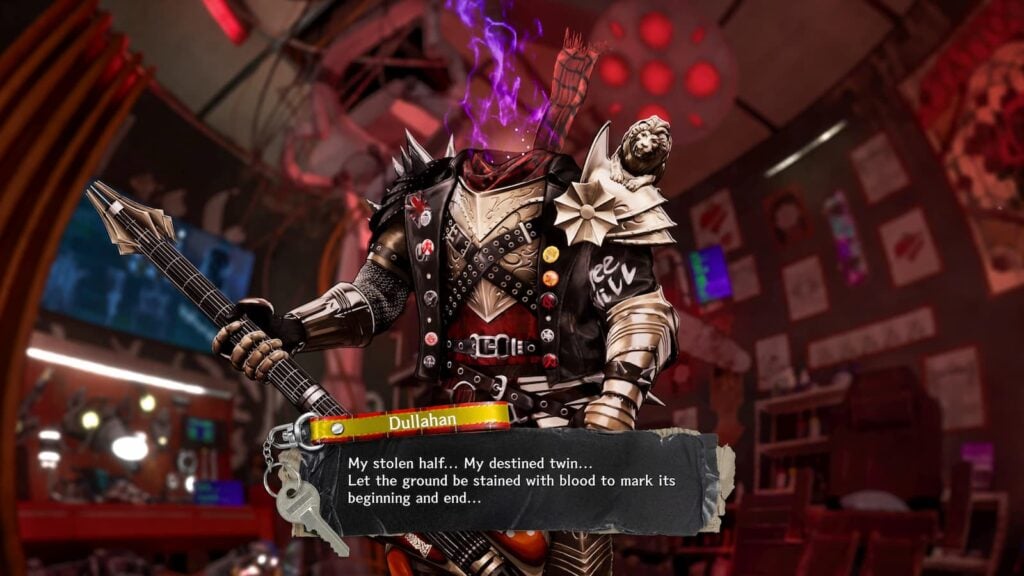
While the gameplay of Stupid Never Dies is fantastic once the game finally gets rolling, it takes quite a bit of time for it to actually get to that point due to the game’s unfortunate pacing issues. The opening hours of the game can be a bit of a slog to get through because of how they’re structured.
Seemingly because the game wants to introduce players to a single mechanic at a time, the player is only able to progress through two layers of the dungeon at the start before being sent back to base to learn about EXP. Then they get access to three layers so they can learn about Style Eat, and so on and so forth.
When a single layer of the dungeon only takes a few minutes maximum to clear, constantly being sent back to base and not having a real chance to actually get used to the gameplay loop and mechanics before you’re bombarded with several more cutscenes and tutorials can be a real drag.
Thankfully, after the first few hours of the game go by, you get the opportunity to actually travel far into the dungeon. The game still only expands a single layer at a time based on how far in the plot you are, but at least traveling down 10, 15, or 20 layers will take some time and actually allow you to enjoy the game’s mechanics.
However, just because the pacing gets better after the first few hours doesn’t mean the same issues won’t rise again later, but in a different form. As near the end of the game, you’ll be asked to refight each of the game’s story bosses again. That wouldn’t be too harsh of an ask if they weren’t all on different versions of the final layer.
To spell out what that means, the game’s plot will suddenly grind to a halt as you’ll need to do a minimum of five extra runs through the dungeon to refight bosses that you’ve already faced in what will be progressively easier fights, as your own level scaling will far outscale theirs.
These pacing issues result in Stupid Never Dies being a game with a slog of an early game, a fantastic middle, and a tedious late game. It’s one of the most bizarrely paced games I’ve ever seen.
An Honest Plot
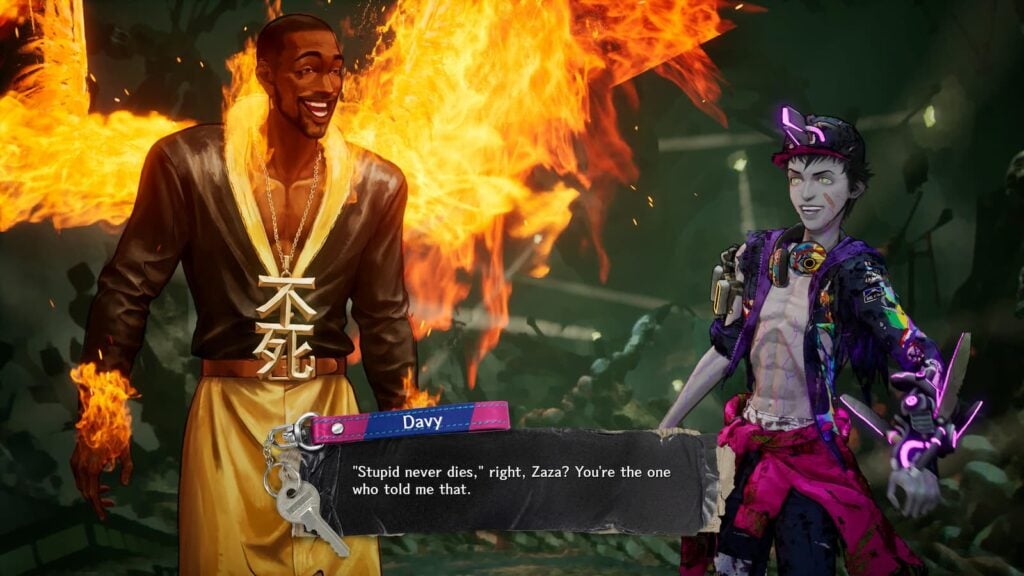
The plot and world of Stupid Never Dies isn’t a serious one. This is a game where a lovestruck zombie named Davy eats a piece of bird poop before flushing himself down a toilet so he can fight against a headless knight who is also a rockstar named Bob Dullahan.
It’s the type of premise that can either come across as joyful or annoying depending on one key factor: A lack of self-awareness.
For the past decade, audiences in every entertainment medium have been bombarded with irony-filled stories like Deadpool or Dungeon Crawler Carl that continuously make jokes about their premise and the tropes of their genre.
Making fun of yourself is a simple and easy way to earn the approval of an audience, making them laugh at you instead of with you. When I first started playing this game, I braced myself for an irony-filled experience that has become ever so common recently. However, this game isn’t like that, as.33 doing so would sacrifice something that is at the core of Stupid Never Dies: its freedom.
It would be so easy for this game to comment on its world elements like werewolf chihuahuas, talking old men trees, or the idea of a human-zombie war and say “Wow, isn’t that ridiculous” or “Huh, that’s so random!” but it never does. There isn’t a single moment in this entire game where it asks the player to laugh at it instead of with it. All of these concepts are free to exist on their own terms and be as silly as they want.
As a whole, silly stories that are afraid of themselves and try to wink and nudge the player into laughing at them instead of along with them can come across as incredibly annoying. Stupid Never Dies avoids this entirely by never making fun of itself and simply being the story it wants to be.
The game’s world and plot are at its core, stupid. In a world. Stupid will never die because audiences want to embrace the ridiculousness without being told to. Is the story in this game high art? No, of course it isn’t, but it’s what it wants to be: fun.
The Julia Problem
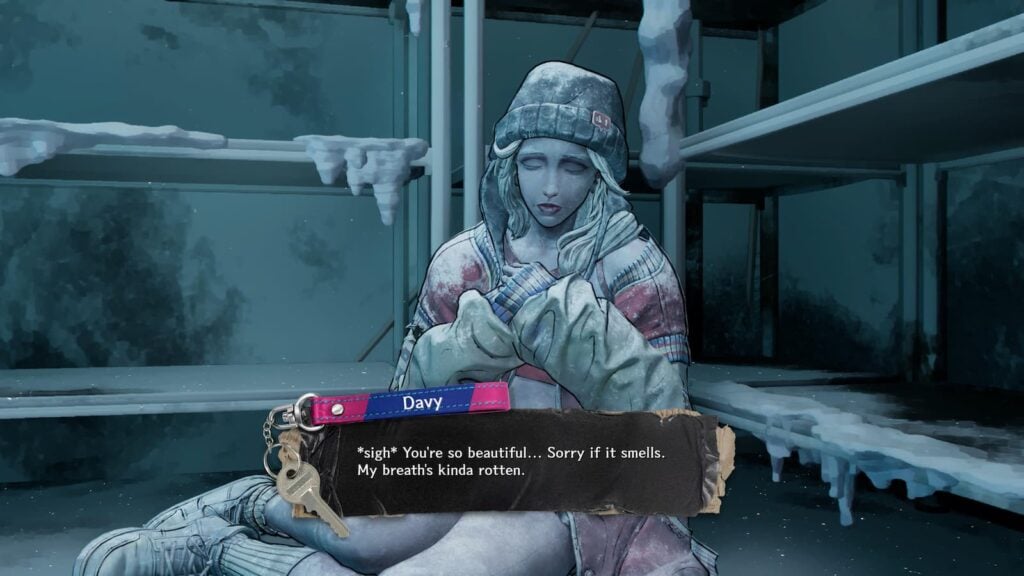
While most of my comments about the experience of playing Stupid Never Dies have been generally positive, there is one glaring issue I had which drastically affected my experience with the game as a whole: The treatment of a major female character: Julia.
After how much presence she had in the trailers and reveal music video for the game, very little could have actually prepared me for how Julia spends the first half of the game, in as literal terms as possible, dead in a refrigerator. While this isn’t her state for the entire game, I feel it is emblematic of how she is treated for the entire story. Even after she becomes an active member of the group, she gets relegated to being a damsel in distress.
Julia is an object of desire; she is treated as a goal that Davy has to work toward the entire game. The idea that she is more than that and would have a right to refuse Davy’s advances even if he were to save her is brought up exactly once before being brushed aside almost immediately.
The game does make some attempt to humanize Julia through being able to read through her social media posts and see that she had a life before the game’s plot began, but even most of these are related to the men in her life. The overall treatment of her throughout the story just feels wrong to me and drastically brought down my enjoyment of the entire experience.
Aside from Julia, the game’s plot is mostly a heartfelt adventure, so I don’t think there was anything malicious behind the way Julia was written; it’s just a consequence. For a game that I mostly enjoyed, to have an issue this glaring feels like an anomaly.
Closing Thoughts

Overall, Stupid Never Dies is a game I am very conflicted on. While I absolutely loved the gameplay and consider this title to be one of the very few roguelikes that I truly enjoy playing, the game’s story and treatment of Julia is still what comes to mind first and foremost.
If I were to describe the experience as a whole in a term, Stupid Never Dies feels like a B-Movie in video game form. The tone of the story is very silly with a bit of heart, and the entire experience clearly had to be made within a smaller budget. That isn’t to say it isn’t well made; what is here is well crafted with action and a gameplay loop that kept me engaged with roguelike mechanics that I typically don’t like.
The experience reminds me of when console and handheld games were actually different things, and the smaller platforms would get lower-budget action games like Code of Princess or Ever Oasis. It’s a style of game that has fallen out of style but is perfect for short pick-up-and-play sessions.
All of that combined also makes it very hard for me to make a call on whether I recommend this game as well. Normally I end these reviews by giving a definitive yes or no on whether a game is right for a specific audience, but this game leaves me too conflicted on that. I suppose all I have to say is to read through this review and make the call for yourself on whether this game is right for you or not.
Stupid Never Dies
Bottom Line
Stupid Never Dies is a game with mountainous highs and abyssal lows. The game's combat and roguelike mechanics are as perfect as they can be, running through the dungeon to eat and become enemies never failed to satisfy me throughout my entire playthrough. However, those aspects are dragged down by the game's slow pacing issues and the story's treatment of Davy's love interest. While I love the game's tone and the enjoy it while I'm playing it, these aspects drag down what could have otherwise been a perfect experience.