Want to see Raider King content first? Add us as a preferred source.
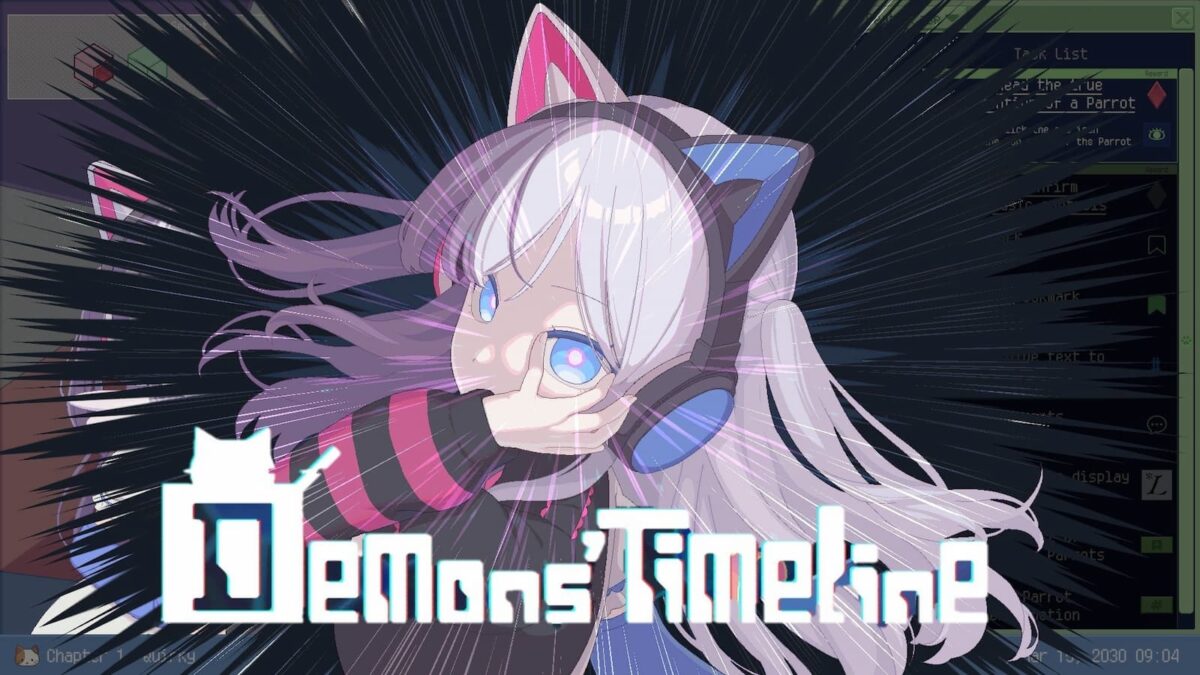
On April 30 2026, indie developer DigitalCats will be releasing their mystery deduction title Demons’ Timeline on Steam. This mystery deduction game will see the player take on the role of the Cyber Detective “L” as they scavenge through posts on the fictional social media platform “Parroter” in order to figure out the identities of various posters and solve seemingly paradoxical crimes. With a thrilling premise and a seemingly cute art style, Is this title worth the time of gamers, or should they log onto another platform? Let’s dissect Demons’ Timeline piece by piece and make the decision for ourselves!
Dynamic Deduction-Based Mysteries
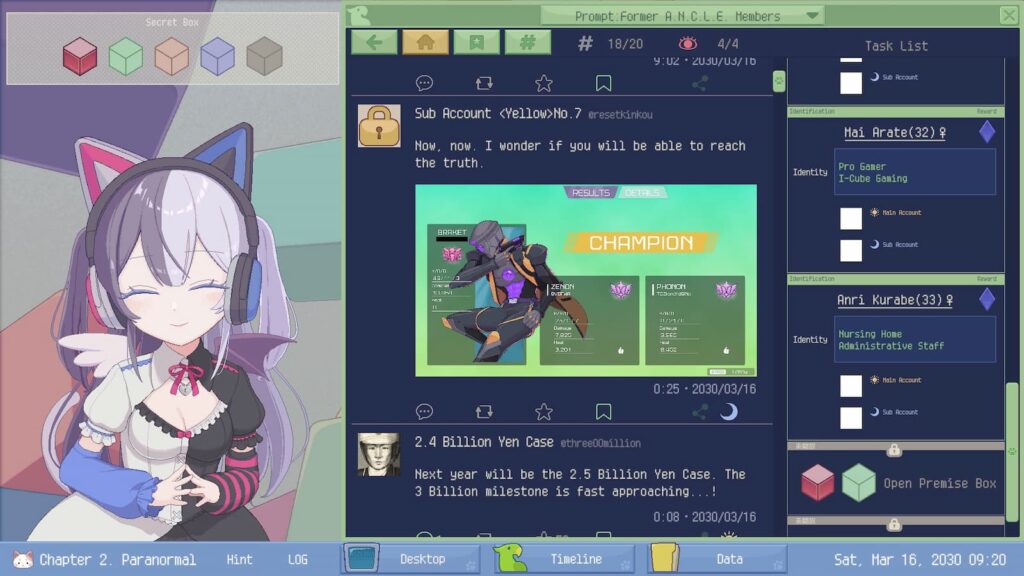
The main gameplay loop of Demons’ Timeline is all about figuring out who people are based on their social media posts. The player will be spending their time scrolling through a timeline of posts, profiles, and hashtags from both people’s public accounts and private accounts.
At the start of each chapter, the player will be given a list of individuals and tasked with marking down both their main account and their alternate sub account. The only information you are given about these characters at the start of the chapter is their name, age, and occupation. Anything else you need to figure out through deduction and context clues.
Figuring out which account belongs to which person requires a lot of careful reading by the player. Sometimes you might be given an obvious clue, like someone’s age being listed in their profile description; other times, you’ll need to dig deeper and make assumptions based on what other accounts are saying about a person.
As the game goes on, the difficulty and the number of posts the player will have to search through will always be increasing. The game wisely doesn’t raise the number of people the player has to identify per chapter too high. After the tutorial sequence, where the player has to identify four individuals, each chapter will range from about eight to nine accounts to identify.
This decision prevents the game from getting too complex to solve solely by virtue of there being too many people. Difficulty increases in Demons’ Timeline come from more interesting angles, like hiding information for your current case in an earlier chapter’s timeline or asking the player to search through images for a hint at an account’s identity.
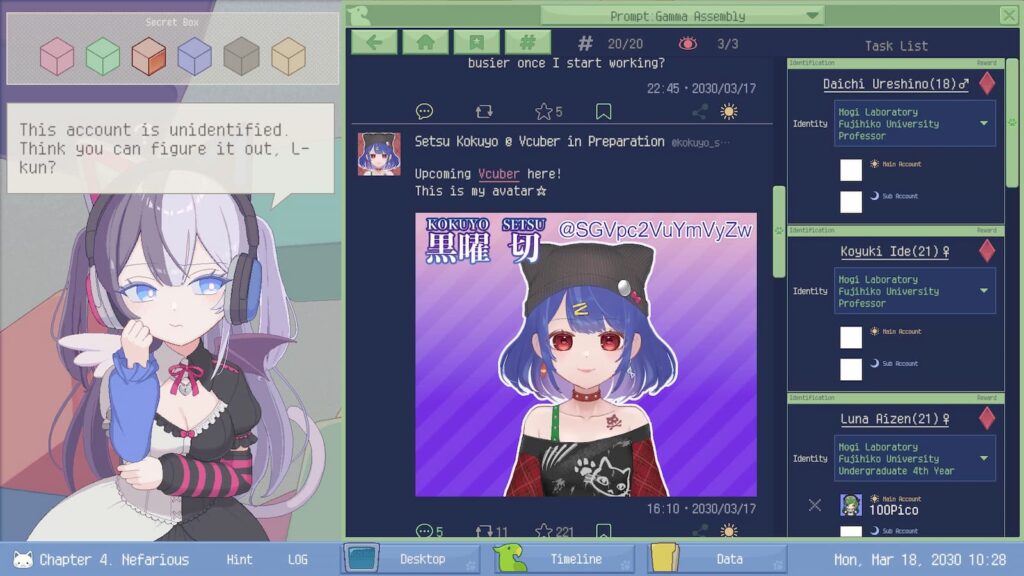
One of the most interesting examples of how the difficulty rises is how the game eventually takes off the training wheels, so to speak, and requires the player to figure out an individual’s job as well as their account. This prevents the player from potentially forcing their way to the solution through random guessing.
The process of solving these mysteries can take quite a while, as the game doesn’t hold back when it comes to making these puzzles difficult. No chapter in this game took me less than an hour. However, the feeling of finally spotting a clue that leads you to attach one account to a specific individual, leading to a domino effect as you piece all of your other clues together, is unmatched and will make the player feel like a genius every time it happens.
After identifying both accounts for each of your suspects, you’ll be asked to look through and quote specific posts to find information that the game asks for. This is done primarily as a knowledge check to make sure you were actually paying attention to what these posts said during your initial search.
Finally, each chapter ends with a recap sequence where the player must assign hashtags they discovered throughout the current social media timeline and answer various yes or no questions. I found this part of the gameplay is less engaging than the account deductions, but I do appreciate that whenever the player fails at this section, they are told the number of questions they got wrong.
Overall, I found the mystery solving and deduction of Demons’ Timeline to be incredibly engaging, and I was hooked from start to finish. The game kept mixing up the type of information the player needed to look for in creative ways and constantly made me want to continue playing.
A Truly Immersive Internet
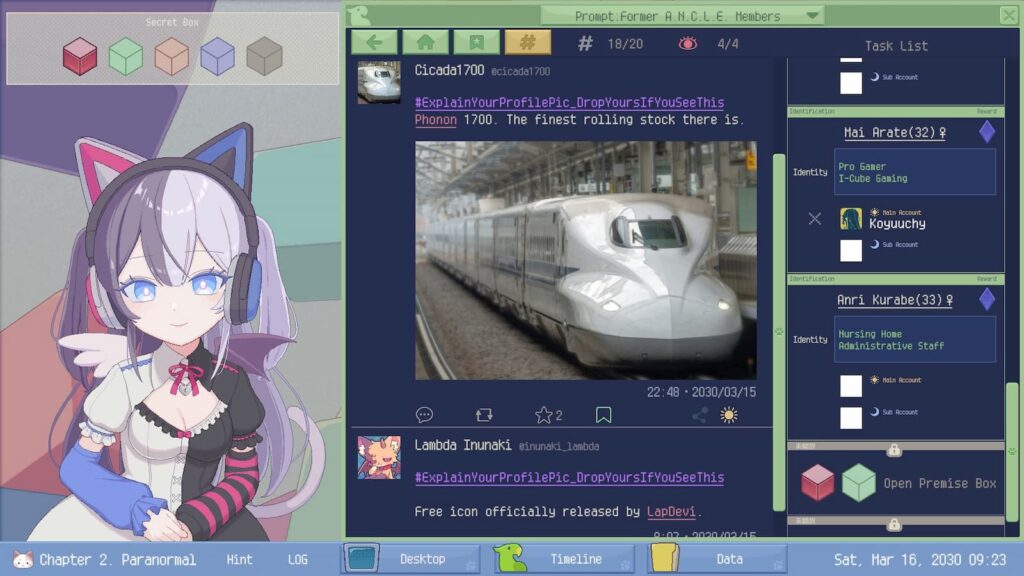
Now that we have gone over the basic gameplay loop of Demons’ Timeline, I would like to go over its version of the internet. Because this is a title about scrolling through social media for information, the game lives and dies on how authentic the posts feel.
One potential hurdle that the game thankfully doesn’t trip over is the potential for the various accounts you’re examining to feel too similar. Every account in this game feels like a unique person and could easily fall into real-life social media poster archetypes we see today.
Chibi artists whose art has spread and become internet memes, YouTubers with less than 1,000 subscribers who constantly share their most recent videos, and indie game devs showing off the latest build of their game. Seeing new people appear on your timeline who are unlike anyone who came before is always a delight.
Of course, for every positive aspect of social media on display, the game makes sure to portray the negative side in equal effect. AI artists who try to pass off their art as real (thankfully, the game itself doesn’t use AI to portray them), grifters who try to cause drama about games being “censored”, trolls who devote their time to telling a Vtuber to quit. Solving the mysteries you are handed will require the player to get waist-deep in the sewage of online discourse.
As the game progressed, I found myself getting incredibly immersed in the timelines on display. I was interested in the changing meta of the hero shooter that many accounts play and argue about, I was laughing at the in-universe memes and copypastas that kept popping up, and I got invested in the internal drama between various characters subtweeting each other.
My immersion was so strong that when I found the profile of No Game No Life writer Yuu Kamiya in the game, I spent several minutes trying to figure out if he was one of the individuals I had to investigate before I remembered he is an actual person and not part of the game.
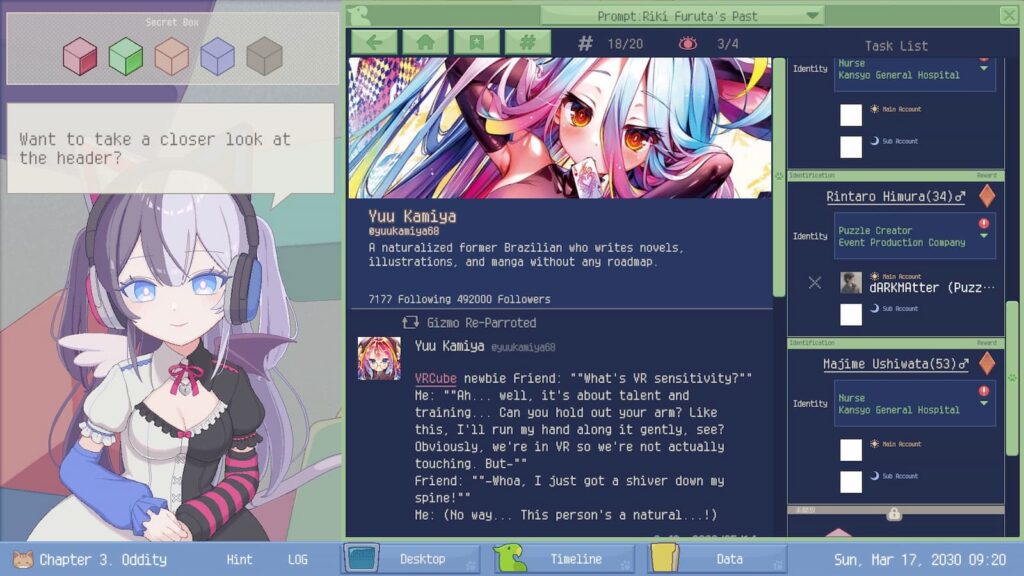
If there is any flaw with the game’s portrayal of the internet, it’s that hashtags are frequently used in nonsensical ways. However, I am willing to forgive this due to how hashtags are used in the gameplay.
Hashtags, quoting, and glossary terms all play their own roles during the process of solving a case and have a unique look to them. I am willing to overlook the strangeness of a character using #killedwithpoison in their post if it means the gameplay sequence of recapping the case works properly.
The internet, as it is portrayed in Demons’ Timeline, might be smaller than other games that try to tackle similar subjects, as it only contains a single website. However, it uses that website incredibly well and perfectly portrays the chaos of social media platforms that put a wide variety of people all within the same space.
Thrilling Visual Variety

Demons’ Timeline is a very visually diverse game, but in a deceptive way. While a majority of your screen will always be covered by blue boxes and white text, like any social media platform, the game’s visuals shine through in the form of the profile pictures and attached images on display.
There is a wide variety of art styles on display here, from traditional artwork to pixel art to even 3D models meant to mimic those that you would see in VR chat.
While not every piece of art is the game is amazing, one image that imitates the style of Wojack webcomics hurt my eyes, which also helps with the game’s immersive internet, as not every image we see online will be a piece of fine art.
Having all of these different art styles not only helped add to the feeling that the player was looking through different corners of the internet for information, but also helped prevent the game from getting visually stale after playing through several chapters in a row.
Closing Thoughts
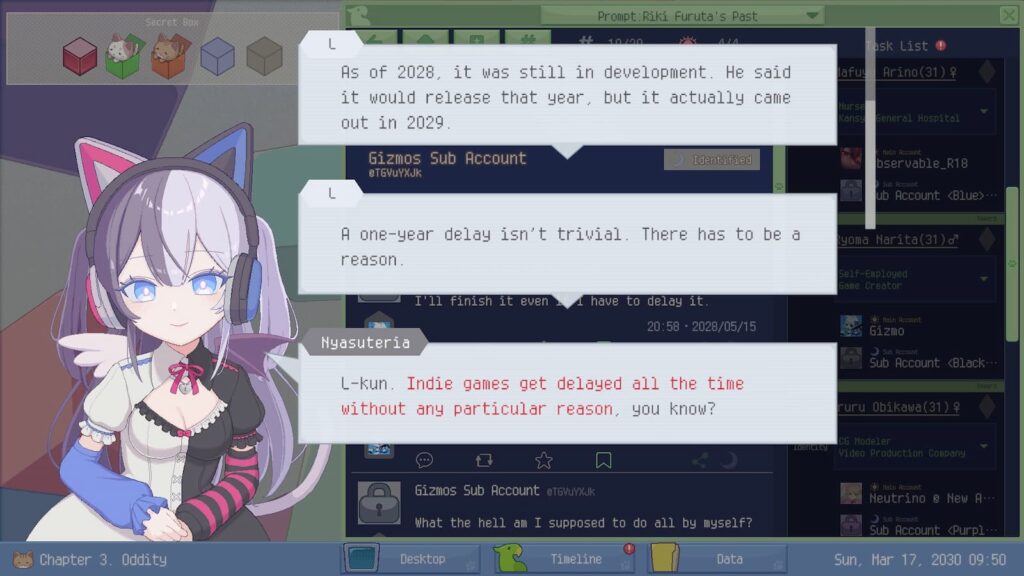
Demons’ Timeline is one of the most unique, creative, and fun deduction games that I have played in recent years. The moment-to-moment gameplay of deducing which account belongs to whom was engaging, its portrayal of a fictional social media platform was immersive, and the visuals on display were impressive.
I heavily recommend that anyone who is a fan of mystery and deduction games pick up and play what I consider to be one of 2026’s hidden gems.
Demons' Timeline
Bottom Line
Demons' Timeline is one of the most creative and fun deduction games in recent years. This game's mysteries and the portrayal of the internet that the player will need to dig through in order to solve them were engaging from start to finish. If you consider yourself a fan of problem solving or mysteries in general, then you owe it to yourself to try playing through this game.


