

Want to see Raider King content first? Add us as a preferred source.
On April 17, 2026, Ace Attorney fans took to social media to talk about the murder of a man called Shadi Smith. They talked about how he was beaten to death with a bottle of grape juice by disgraced ex-lawyer Phoenix Wright as if it were a real event that happened on the news.
This was actually the continuation of a trend that began in 2016. Because the Ace Attorney franchise takes place several years in the future, fans began to post about the events of the games as if they were actual breaking news. With each event in the games having a month and day attached to it that displayed at the beginning of each scene, doing this was incredibly easy.
Due to the multi-year timeskip between 2004’s Ace Attorney: Trials & Tribulations and 2007’s Apollo Justice: Ace Attorney, fans have been unable to make posts like these in a long time. The last Ace Attorney event before this most recent murder occurred in April 2019, when the final case of 2012’s Ace Attorney: Investigations 2 took place. In many ways, being able to make fun posts like this again felt like a return to a forgotten time for Ace Attorney fans.

This fandom trend of pretending that each news event in the games is actually happening in our reality will likely continue until September 30, 2028. After that date (which marks the ending of Ace Attorney: Spirit of Justice’s DLC Turnabout Time Traveler) passes, there will be no more events for fans to react to. With no new Ace Attorney games releasing since 2017’s The Great Ace Attorney 2, there is naturally an endpoint in events on the franchise’s calendar.
Ace Attorney, taking place in the near future, has always been an interesting aspect of the franchise. While fans of the franchise will talk about that fact as if it is an integral part of the franchise’s setting, stating that the court system portrayed in the games is a hypothetical dark future for the legal system, a newcomer to the franchise could be easily forgiven for not realizing that was part of the series at all.
Even if one were to put aside details like every character using a flip phone or Phoenix referencing the mid-2000s internet meme “This is Sparta” as just signs that the games are products of their time, it’s hard to place a futuristic feeling on nearly any part of the game. Even the dates and times at the start of each case only mention the month each case takes place in, with no mention of the year.
So, where did this belief that the games take place in the future come from? The answer is actually quite simple, as there is one moment in the very first game where a year is stated.
During the fourth case of Phoenix Wright: Ace Attorney, Turnabout Goodbyes, the player must solve a past case known as the DL-6 Incident during the final trial sequence of the trailer. When this ‘Bonus Round’ of the case begins, the player will receive a file meant to recap them on the details of this case. The first line of this file states that this murder. which occurred 15 years ago in story, took place on December 28, 2001.
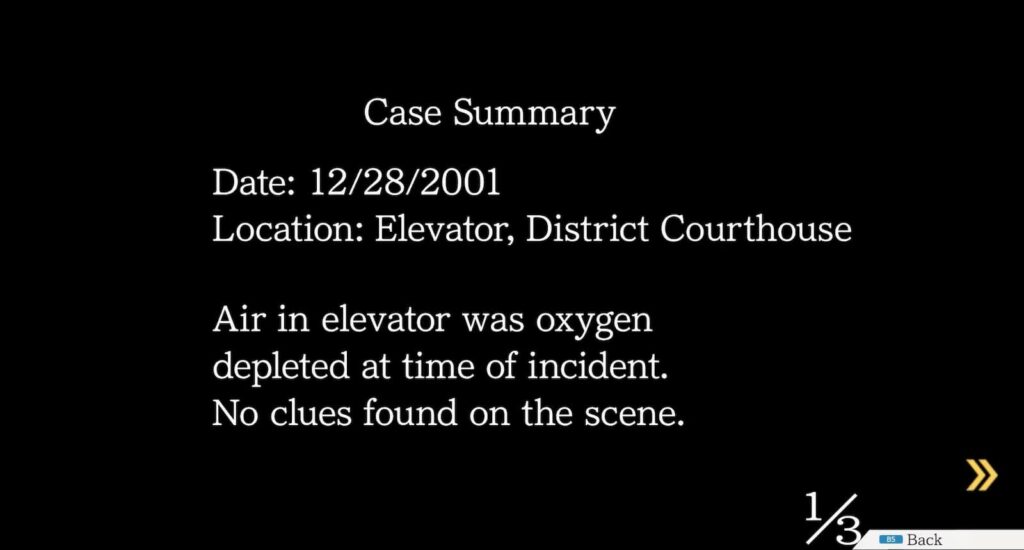
The single line of dialogue where Phoenix states that the incident happened in 2001 is the only time in the entire franchise where a specific year is stated. While this does firmly place the first Ace Attorney game in 2001, and thus gives us an entire franchise timeline where each game takes place one year after the previous, unless stated otherwise, there are some issues with taking this date at face value.
2001 is not a year that was chosen at random, as it was actually the year the very first Ace Attorney game was released in Japan. With this game having been developed in only six months, I believe that the 2001 date was merely chosen out of quick convenience and not as a way of intentionally setting the franchise in the future.
At no other point in the franchise will the player encounter a year or even any implication that the franchise takes place in any time other than where they were released. If one were to play any game in the franchise, especially now that we’re far away from the year 2001, one could be forgiven for not even realizing that the series technically takes place in the future.
Interestingly enough, there actually is one piece of Ace Attorney media that does appear to treat the Ace Attorney franchise taking place in the future as an actual part of the setting that would differentiate it from our world.
Takashi Miike’s 2012 live-action movie adaptation of the franchise, simply titled Ace Attorney, portrayed the court system and judicial proceedings as a type of public event that people could buy tickets to, like a concert. Inside these courtrooms were giant holographic projectors that could be used to throw the images of evidence around or analyze it for small details that everyone could see.
This movie is by far one of the most unique interpretations of the Ace Attorney franchise and its gameplay out of the adaptations we’ve seen. With actions that the player could take, like presenting evidence in the middle of a testimony, being shown as big moments that could shake the entire room.
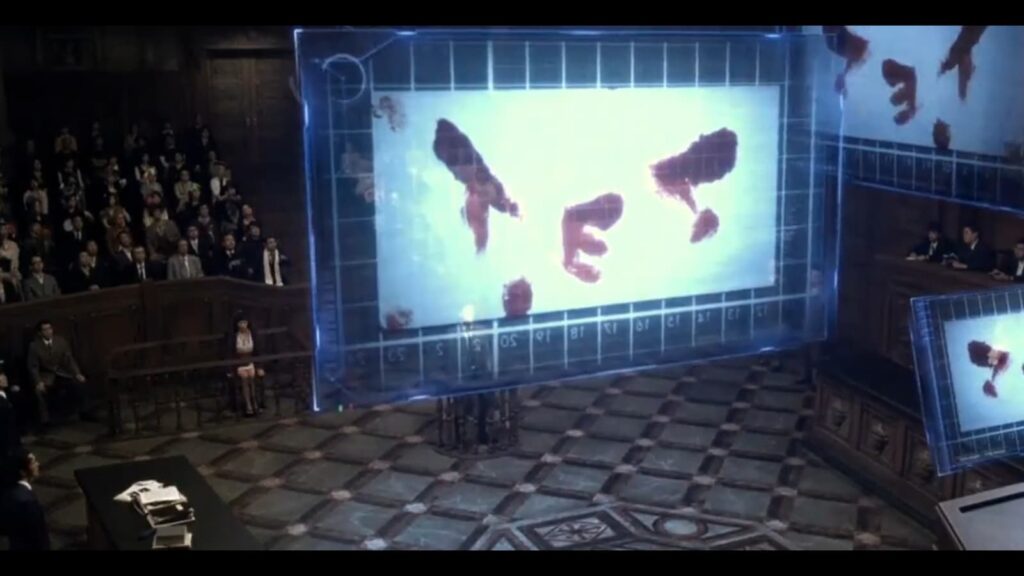
There is even some subtle political commentary here as the film shows that while large cases that will garner plenty of media attention, like the DL-6 Incident, are given full use of holographic tech, smaller-scale cases, like the opening case, where Larry Butz is accused of murdering his girlfriend, are conducted in cramped, dirty rooms without any of this technology. The system is rigged with a 99% conviction rate, and the downtrodden aren’t even given the same courtroom privileges to be properly defended.
Now, while these holographic projectors and the other technology on display in the movie do make the franchise actually feel like it takes place in the near future, part of me doubts this was fully intentional or a priority in Miike’s mind.
Any adaptation of this franchise is going to struggle with properly showcasing the gameplay in a way that feels visually interesting while also keeping the spirit of looking through the court record for clues. The Ace Attorney anime in particular struggled with this. A common complaint was that each episode felt too fast-paced, with Phoenix figuring out each contradiction within seconds. Visually, it struggled as well, with any evidence that Phoenix couldn’t feasibly have in his pocket being instead displayed on a small T.V. in the courtroom.
With all this in mind, I feel like the holographic projectors in the movie’s courtrooms were part of the movie as a way to portray the actions of presenting evidence or examining it for small details in a way that is visually engaging for the viewer. The fact that this stylistic visual choice happens to match the one line of dialogue from the first game that sets the franchise in the future is more of a happy coincidence than anything.
In truth, the Ace Attorney franchise cares very little for the dates and times that events occur. The short sequences where a date and time are typed out at the beginning of each case are done merely to maintain the aesthetic of a legal proceeding and not for keeping a timeline of events.
The actual dates that events take place on matter so little that they can even be changed to meet the writer’s whims. The Ace Attorney anime (which coincidentally aired in 2016, the year the first game takes place) actually changed the date of the game’s first case from August to May.
I could bring up other details about the franchise and how they either support or disprove it taking place in the future, but I feel like even arguing about it buries a very large aspect of the Ace Attorney franchise: The politics of its court system and how it parodies our world.
Ace Attorney is a very contemporary franchise. Its central premise is not to show a hypothetical future of the legal system but to parody the Japanese legal system as it existed in 2001 and how it exists at the time each game releases. The courts of Ace Attorney having an outrageously high conviction rate as any argument a defense attorney has is shrugged off without absolute proof is merely a representation of a real country with a legal system that judges people as being guilty until proven innocent.
While the politics of Ace Attorney can often take the backseat or be forgotten as the player focuses on the character-focused stories in each game, this has always been part of the franchise and has even influenced various plotlines. The central conflict and resolution in the final case of 2007’s Apollo Justice: Ace Attorney centers around the importance of juries and how a legal system that relies only on attorneys and Judges will inevitably result in the truth being lost.
This plotline didn’t come from nowhere. In 2007, Japan was in the midst of introducing a jury system to its courts, with the first trial to use this system occurring in 2009. A franchise designed to parody the legal system is naturally going to have plotlines that reflect changes in that legal system as they happen.
Apollo Justice: Ace Attorney is the most overtly political game in the franchise, but even the games that came after included satire of current events in their writing. 2016’s Ace Attorney: Spirit of Justice, for example, had a character who was a parody of real-life politician Ryutaro Nonomura, who was accused and sentenced for fraud during the development of the game.

Ace Attorney does not take place in the future; it never has. Despite what a single line of dialogue in the first game may say, each game takes place when it is released and is a reflection of the times that it was written in. That contemporary feeling can take the form of actual politics or references to internet memes that were popular at the time of writing.
However, despite all of that, it is indeed incredibly fun to make posts on social media acting like every major event in the series is actually happening. This feature was not put together as a means of discouraging fans from interacting in the franchise in this way (As I do it as well), but merely as a way of analyzing the franchise from a different angle and educating others about how this future setting came about in the first place.


This is a very insightful article! I’d always taken for granted most of the deeper political implications of Ace Attorney and its reflections of the current times in Japan, thinking about each game’s development of the legal system only in the context of the story being told rather than why that story was chosen to be told at all, but this article gave me a lot to think about. Thank you for writing out and sharing your thoughts!